Post-Workout Smoothie Recovery: The Amazing Guide
Most post-workout smoothie recovery advice boils down to one instruction: drink something with protein and carbs soon after you train. That’s true, but it skips the parts that actually change how the smoothie works — how “soon” really needs to be, how much of each nutrient makes sense for your size and workout, and where a smoothie stops being useful and just becomes a snack with good marketing. This guide walks through all of it, including the parts most recipe roundups leave out.
What Your Body Actually Needs for Post-Workout Smoothie Recovery
Exercise does two things worth caring about here. It depletes glycogen, which is the stored form of carbohydrate your muscles use for fuel, and it creates small amounts of muscle protein breakdown that need amino acids to repair. A post-workout smoothie is really just a fast, low-effort way to deliver both of those things in a form your body can absorb quickly, without needing to sit down for a full meal.
Carbohydrates refill glycogen. Protein supplies the amino acids for repair, and leucine in particular seems to be the trigger that gets muscle protein synthesis going. Fluid replaces what you sweated out, and a well-built smoothie handles that automatically since it’s mostly liquid to begin with. The National Institutes of Health’s consumer guide to nutrition for exercise and athletic performance covers this same territory in more depth if you want the fuller picture.
None of this requires anything exotic. It’s the same basic mechanism whether you ran, lifted, or did an hour of cycling — the ratios shift a little by activity type, which the next section gets into, but the underlying need is consistent.
Bottom Line: Post-workout smoothie recovery earns its place by delivering carbs, protein, and fluid quickly and easily — not because smoothies have some special property recovery drinks in a can don’t.
Why the “30-Minute Window” Gets Repeated More Than It Deserves
You’ve probably seen the claim that you have a 30-to-45-minute “anabolic window” after training to eat or the workout is somewhat wasted. It’s one of the most repeated ideas in fitness content, and it’s also more rigid than the current research supports.
The International Society of Sports Nutrition’s position stand on nutrient timing, published in the Journal of the International Society of Sports Nutrition, describes the useful window as considerably wider than 30 minutes for most people — closer to a few hours on either side of a workout, especially if you ate a normal meal within a couple of hours before training.
The urgency of that narrow window matters more for people training multiple times a day, or for those training in a fasted state, than it does for someone doing one workout and eating normally the rest of the day.
That doesn’t make timing irrelevant. It just means a smoothie you drink 90 minutes after your workout isn’t failing you the way some advice implies. What matters more consistently is that you get adequate protein and carbohydrate somewhere in the hours around training, not that you hit a specific clock.
Quick Summary
- The rigid “30-minute window” is an oversimplification of the current sports nutrition research.
- A realistic target is within a couple of hours post-workout, not immediately.
- Total daily protein and carbohydrate intake still matters more than the exact timing.
Figuring Out Your Own Ratio Instead of Copying One Number
A lot of smoothie guides hand you a single ratio — usually somewhere around 3-to-1 or 4-to-1, carbs to protein — and stop there. That number comes from real research, but treating it as one-size-fits-all skips the part where your body weight and workout intensity actually change what “3-to-1” means in grams.
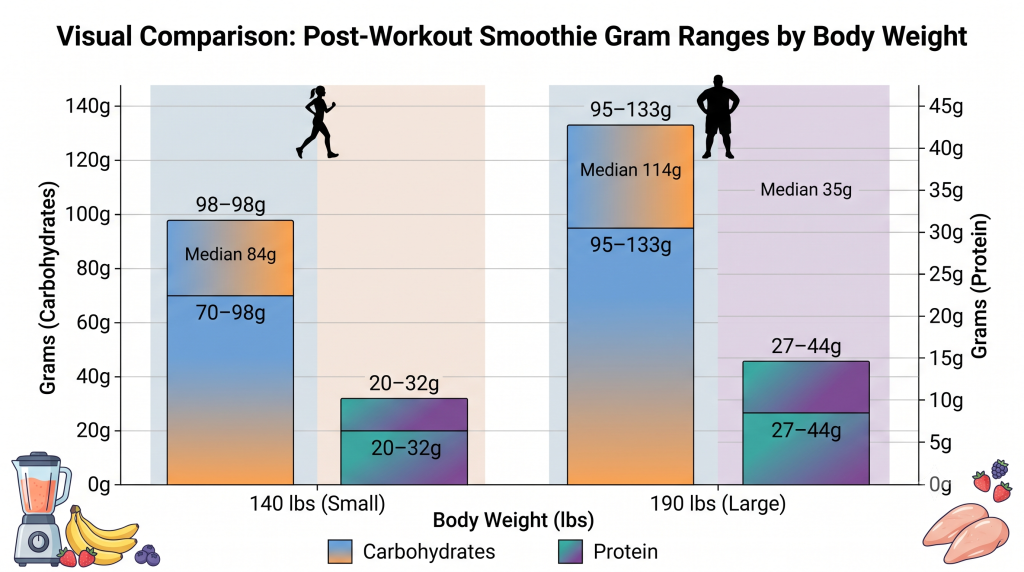
A commonly cited starting point is roughly 0.5–0.7 grams of carbohydrate and 0.14–0.23 grams of protein per pound of body weight, consumed in the hours around a workout. For a 140-pound person, that lands somewhere around 70–98 grams of carbohydrate and 20–32 grams of protein. For a 190-pound person doing the same workout, it’s closer to 95–133 grams of carbohydrate and 27–44 grams of protein. Those aren’t small differences, and a single fixed recipe can’t account for both.
Intensity and duration shift things too. A 30-minute recovery walk doesn’t deplete glycogen the way an hour of interval training does, and the smoothie that makes sense after each one probably shouldn’t be identical. On lighter training days, leaning toward the lower end of that range — or skipping the smoothie in favor of your next regular meal — is a reasonable call.
In Short:
- Use body weight, not a flat number, as your starting point for carbs and protein.
- Heavier training sessions justify amounts toward the higher end of the range.
- Light activity days don’t need the same smoothie a hard session does.
What Actually Goes in the Blender
Once you know roughly what you’re aiming for, building the smoothie is mostly a matter of picking one item from each category below.
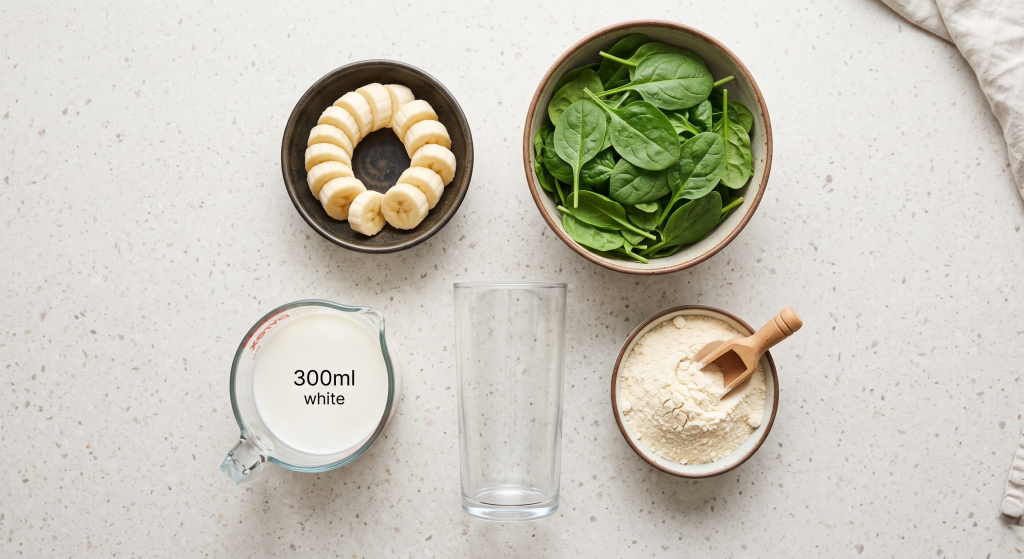
Carbohydrate base. Banana, mango, or pineapple are common choices because they blend smoothly and add natural sweetness without needing added sugar. Oats are a slower-digesting option if you want the smoothie to double as something more filling.
Protein source. Whey protein blends the smoothest and dissolves most easily into a thin liquid. Plant-based blends (pea, soy, or a mixed blend) work fine but can turn slightly gritty in a thin smoothie — thickening the base with oats or yogurt usually fixes that. Greek yogurt or cottage cheese are whole-food protein options that also add creaminess.
Liquid. Dairy milk, unsweetened plant milk, or plain water all work — this is mostly a matter of preference and how thick you want the result, since it doesn’t meaningfully change the nutrition profile at the volumes used in a typical smoothie.
Optional extras. Frozen spinach or kale adds volume and micronutrients without changing the taste much once blended with fruit. A spoonful of nut butter adds healthy fat and a fuller texture, though it will slow down digestion slightly, which matters if speed of absorption is the priority.
None of these choices need to be exact. The ratio math in the previous section is a target range, not a formula that breaks if you’re a few grams off.
Situations That Change the Answer
Training fasted or first thing in the morning. The case for getting carbs and protein in sooner rather than later is stronger here, since you’re starting from a lower glycogen state than someone who ate a few hours before training.
Two workouts in one day. This is where the tighter timing window research is actually most relevant — if you’re training again in under eight hours, getting carbohydrate in promptly helps you show up for the second session in better shape.
Dairy-free or vegan. Swap whey for a pea or soy-based protein powder, and use a plant milk as the liquid. The ratio targets don’t change — only the ingredients do.
Trying to lose body fat. The post-workout smoothie doesn’t need to disappear, but it does need to fit inside your total daily calorie target the same as any other food. Cutting the portion down rather than eliminating it is usually the more sustainable adjustment.
Very short or low-intensity sessions. A 20-minute walk or a light mobility session doesn’t create much of a recovery demand. A full-sized recovery smoothie after one of these is probably more calories than the session justifies.
Key Takeaways
- Fasted training and same-day double sessions are the two scenarios where timing matters most.
- Dietary restrictions change the ingredients, not the underlying ratio targets.
- Not every workout needs the same recovery smoothie — light sessions can call for less or none at all.
Where This Can Go Wrong
A smoothie is easy to build badly, usually in one of a few predictable ways.
Too much added sugar. Fruit brings its own natural sugar, and that’s fine — it’s the honey, maple syrup, or flavored protein powder stacked on top that pushes a smoothie from “balanced” to “dessert with a workout excuse.” If you’re already using sweet fruit as the base, extra sweeteners are rarely doing the smoothie any favors.
Treating it as a full meal replacement. A smoothie is genuinely good at delivering carbs, protein, and fluid quickly. It’s less good at delivering the full range of nutrients — fiber from a variety of sources, fats beyond whatever’s blended in, and the simple satiety that comes from chewing — that a full meal provides. Using it as a fast recovery step before a real meal later works better than leaning on it as the meal itself, every day.
Ignoring your actual thirst and hunger cues. The gram ranges in this guide are a starting point, not a mandate. If a smoothie built to the “correct” ratio consistently leaves you too full to eat normally later, or too hungry an hour after, that’s useful information — adjust the recipe rather than the rule.
Assuming more protein is automatically better. Past a certain point — generally accepted to be somewhere around 20–40 grams in one sitting depending on body size — additional protein in a single smoothie mostly just adds calories rather than additional muscle-repair benefit. Spreading protein across the day matters more than maximizing any single serving.
Questions Worth Answering Before You Blend
Does it matter if I use frozen fruit instead of fresh? Not nutritionally. Frozen fruit is usually picked and frozen close to peak ripeness, and it gives the smoothie a thicker, colder texture without needing ice.
Can I make it the night before? The blended smoothie itself is best within a day, since texture and color start to change after that. Pre-portioning the unblended ingredients into a bag or container and blending fresh the next morning holds up better.
Is post-workout smoothie recovery actually better than a recovery shake or bar? Not inherently — the body doesn’t care whether the carbs and protein arrive in liquid or solid form. A smoothie’s real advantage is that it’s easy to customize, easy to drink quickly, and can include whole foods a packaged shake can’t.
What if I don’t like the taste of protein powder? Greek yogurt or cottage cheese can supply most or all of the protein instead, especially in a fruit-forward smoothie where their tang blends in easily.
Do I need to hit the exact gram targets every time? No. The ranges in this guide are a reasonable starting point for someone who wants a rough system, not a requirement to track precisely after every workout.
Post-workout nutrition doesn’t need to be complicated to be effective. Knowing roughly what your body needs, why the timing matters less than it’s often made out to, and which ingredients actually earn their place in the blender is enough to build a smoothie that does its job — no tracking app required.