
Cheap vs Expensive Blender for Smoothies: Texture and Durability Test
When deciding between a cheap vs expensive blender for smoothies, the primary trade-offs come down to micro-emulsification quality, motor torque durability, and long-term heating control. Budget blenders ($30 to $80) rely on sharp blades and high RPMs to chop ingredients, which works well for soft fruits and liquids but struggles with dense fibrous greens like kale or unsoaked chia seeds. High-end blenders ($300 to $500+) utilize high-horsepower motors and dull, thick aircraft-grade stainless steel blades to pulverize cell walls without heating the mixture. This comparison breaks down the real texture differences, motor lifespan expectations, and routine fit so you can make an informed choice.
Quick Summary
- Budget blenders chop ingredients using sharp blades, often leaving grit or berry seeds in dense blends.
- High-end blenders pulverize cell walls with high-torque motors, yielding completely smooth, velvety textures.
- Motor thermal protection in expensive models prevents burn-out during thick frozen or nut-butter blends.
- A budget blender lasts 1 to 3 years of daily use, whereas premium models routinely exceed 7 to 10 years.
Scope: Evaluating High-End vs Budget Blenders for Daily Smoothies
This evaluation focuses specifically on home smoothie preparation using common ingredients such as frozen berries, leafy greens, ice, plant proteins, and fibrous seeds. It examines how mechanical motor design and container aerodynamics alter final drink quality over repeated morning routines.
This scope explicitly excludes commercial kitchen applications, hot soup preparation functions, specialized food processing attachments, and low-volume travel cups. The goal is to clarify whether the price jump translates to noticeable daily value for a regular smoothie drinker.
Evaluation Criteria: What Actually Separates Blender Price Tiers?
The performance gap between blender price tiers rests on three physical pillars: motor torque under load, blade geometry, and air-flow vortex design inside the pitcher. Budget motors often spin fast when empty, but slow down drastically once frozen fruit or thick ice is introduced.
When a motor bogs down, friction heat transfers directly into the container. This warms cold smoothies, oxidizes sensitive greens, and degrades taste, a performance issue frequently highlighted in testing by Consumer Reports. High-end machines maintain consistent blade speed under heavy loads, pulling ingredients downward into a continuous vortex without overheating the drive socket.
What We Like
- High-end models create silky textures with tough greens like kale and spinach.
- Budget units feature lightweight pitchers that are easy to store and wash by hand.
- Premium drive sockets use metal-on-metal couplings for enhanced longevity.
Keep in Mind
- High-performance blenders require significant counter space and generate higher noise levels.
- Budget blenders can overheat if run continuously for more than 60 seconds on heavy blends.
Cheap vs Expensive Blender for Smoothies: Texture and Durability Test
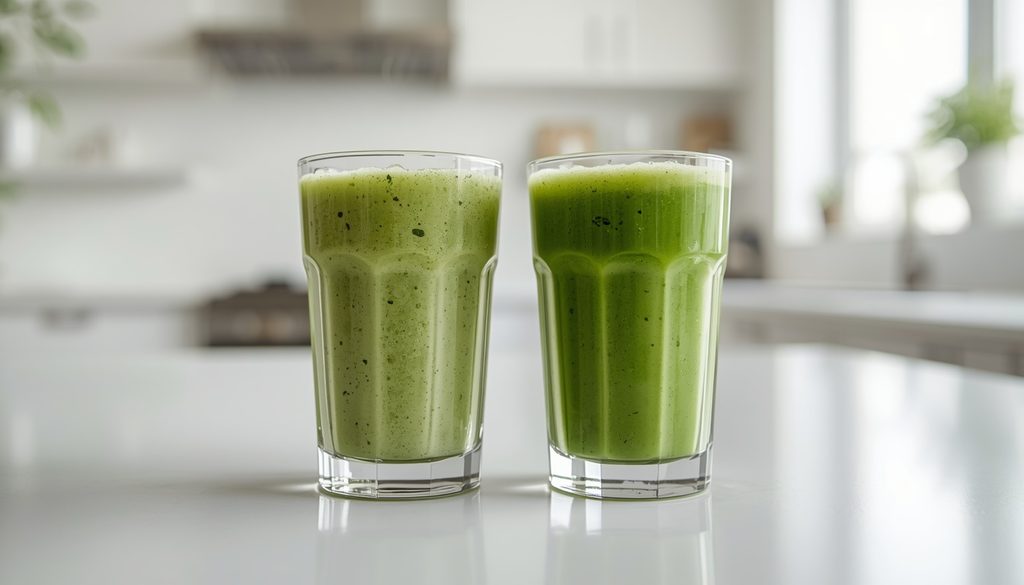
In direct texture evaluations, the contrast is most evident with fibrous ingredients and blackberry or raspberry seeds. A budget blender leaves suspended seed fragments and leafy flecks, creating a textured mouthfeel that requires chewing. A high-end unit homogenizes those same seeds into a uniform liquid.
Durability over time also varies significantly. Entry-level blenders frequently use plastic drive couplings that wear down or strip after prolonged contact with ice. Premium blenders feature solid metal drive gears backed by thermal overload switches, preventing the motor from burning out when handling thick mixtures.
Key Takeaways
- Texture consistency is driven by motor torque rather than initial blade sharpness.
- Plastic drive gears on budget units are the primary failure point during heavy daily use.
- High-end containers pull dense ingredients into an active vortex without requiring excess liquid.
| Evaluation Factor | Budget Blender ($30 – $80) | High-End Blender ($300 – $500+) |
|---|---|---|
| Leafy Green Texture | Small flecks present; slightly chewy | Completely micro-emulsified and smooth |
| Berry Seed Breakdown | Seeds remain largely intact at bottom | Pulverized entirely into drink |
| Drive Socket Material | Hard plastic or rubber composite | All-metal hardened steel coupling |
| Expected Lifespan | 1 to 3 years with daily use | 7 to 10+ years with daily use |
Suitability Filter: Which Blender Price Tier Matches Your Routine?
Choosing the right blender depends entirely on your daily smoothie composition and long-term usage habits. Neither option is universally superior; each solves a different kitchen necessity.
A budget blender is ideal if:
- Your recipes rely mostly on soft fresh fruits, milk, yogurt, and banana bases.
- You blend 2 to 3 times per week rather than multiple times every day.
- Counter space and initial financial investment are your primary constraints.
A high-end blender is ideal if:
- You regularly process raw kale, frozen root vegetables, nuts, or whole seeds.
- You drink a daily green smoothie and dislike pulpy or textured mouthfeel.
- You prefer buying a single durable kitchen tool that lasts for many years.
Blending & Freshness Tip: Always pour liquids and fresh ingredients in first, followed by powders, greens, and frozen items on top. This weight pushes ingredients into the blades naturally, reducing strain on budget motors.
Risks and Limitations: Potential Pitfalls of Both Options
Budget blenders carry the risk of premature motor burnout if pushed beyond their design limits. Running a 300-watt motor on heavy ice loads without adequate liquid can melt plastic gears or trip internal thermal fuses permanently.
Conversely, high-end blenders require a substantial upfront investment and take up considerable vertical cabinet clearance. They are also significantly louder during operation, as documented in acoustic and motor evaluations by The New York Times Wirecutter, which can be a consideration for early morning routines in shared households.
Final Decision Framing: Balancing Upfront Cost Against Smoothie Consistency
Evaluating a blender purchase requires balancing immediate budget constraints against long-term replacement cycles. Buying three budget blenders over six years often equals the cost of one mid-to-high-tier machine, without offering the superior texture quality of a high-torque motor.
If silky green smoothies are essential to your morning wellness habit, investing in high motor torque offers measurable daily satisfaction. If your routine revolves around simple fruit protein shakes, a budget model delivers adequate value without overextending your kitchen budget.
Bottom Line
- Soft fruit smoothies perform adequately in budget machines with sufficient liquid.
- Fibrous green drinks and frozen concoctions require high-torque motors for true smoothness.
- Consider total cost of ownership: high-end units cost more upfront but avoid frequent replacements.
Frequently Asked Questions
Does a cheap blender destroy nutrients in a smoothie?
No, a cheap blender does not destroy nutrients. While friction heat from a struggling motor can slightly warm a smoothie, it does not alter macro or micronutrient availability significantly during a standard 60-second blend cycle.
Can a budget blender crush ice effectively?
Budget blenders can crush ice if combined with sufficient liquid. However, blending dry ice or heavy frozen fruit without liquid strains entry-level motors and risks dulling or bending thin blades.
Why do high-end blenders have dull blades?
High-end blenders rely on motor power and blade speed to pulverize food rather than sharp edges. Dull, thick stainless steel blades shatter rigid cell walls under extreme impact velocity and do not dull over time.
How long should you blend a smoothie in a budget machine?
Blend for 45 to 60 seconds maximum per cycle. If ingredients remain unblended, pause for 30 seconds to let the motor cool, stir the pitcher contents manually, and run a second short pulse.
Is a tamper tool necessary for making thick smoothie bowls?
Yes, a tamper tool allows you to push thick frozen ingredients down into the vortex without stopping the motor. High-end blenders include custom tampers designed not to touch the spinning blades.
What causes a blender to smell like burning plastic?
A burning smell indicates the motor is overheating under high load, or the rubber/plastic drive socket is slipping against the gear. Stop blending immediately and allow the unit to cool down completely.
Selecting between blender tiers ultimately comes down to matching machine capabilities with your preferred ingredients. Understanding these mechanical trade-offs ensures a comfortable purchase decision that supports a consistent, refreshing smoothie routine every day.