
Smoothie Blender Buying Guide: Wattage, Blades, Jars, and Noise
Choosing the right machine requires looking beyond marketing claims to understand four physical factors: motor power, blade structure, container construction, and sound output. This comprehensive smoothie blender buying guide explains how wattage, blade aerodynamics, jar durability, and decibel levels dictate blending performance and long-term utility in your kitchen.
Quick Summary
- Motor Wattage & Torque: Aim for 1,200 to 1,500 continuous peak watts to process frozen fruit and fibrous greens without overheating.
- Blade Design: Dull, laser-cut stainless steel blades relying on high rotational speed crush ice far better than sharp, thin blades.
- Jar Materials: BPA-free Tritan co-polyester offers lightweight impact resistance, while heavy glass prevents scratching from hard seeds.
- Noise Levels: Standard high-performance blenders range from 85 to 95 dB; sound enclosures reduce noise down to conversation level (70–75 dB).
What Motor Wattage and Peak Horsepower Really Mean
Motor wattage indicates the electrical power input of a blender motor, but continuous torque determines how well it maintains speed under heavy resistance. When processing dense frozen bananas, raw carrots, or fibrous kale, a low-wattage motor slows down, causing friction heat that warms cold smoothie ingredients.
For basic fruit smoothies using fresh berries and yogurt, a 600-watt to 900-watt motor is sufficient. However, daily green smoothies containing raw fibrous roots or ice chunks demand between 1,200 and 1,800 peak watts. High-power motors maintain blade rotation speed, creating a smooth emulsion rather than leaving gritty leaf fragments behind.
Blade Engineering: Sharpness vs. Rotational Velocity
A common misconception is that blender blades must be razor-sharp to pulverize ingredients. In high-performance blending, thick, dull-edged blades operating at speeds exceeding 20,000 RPM perform superior work by pulverizing cell walls through sheer kinetic force rather than slicing them.
Blade angle and vortex creation are equally critical. Four-pronged stainless steel blades angled upward and downward draw ingredients toward the container base. If the blade assembly creates a localized cavity around itself—a phenomenon known as cavitation—the vortex collapses and ingredients stop circulating smoothly.
Jar Materials Compared: Glass, Tritan, and Stainless Steel
The container material impacts thermal retention, total weight, clarity, and physical longevity. Blender jars undergo intense vibration and physical stress during high-speed operation, making material selection a core structural consideration.
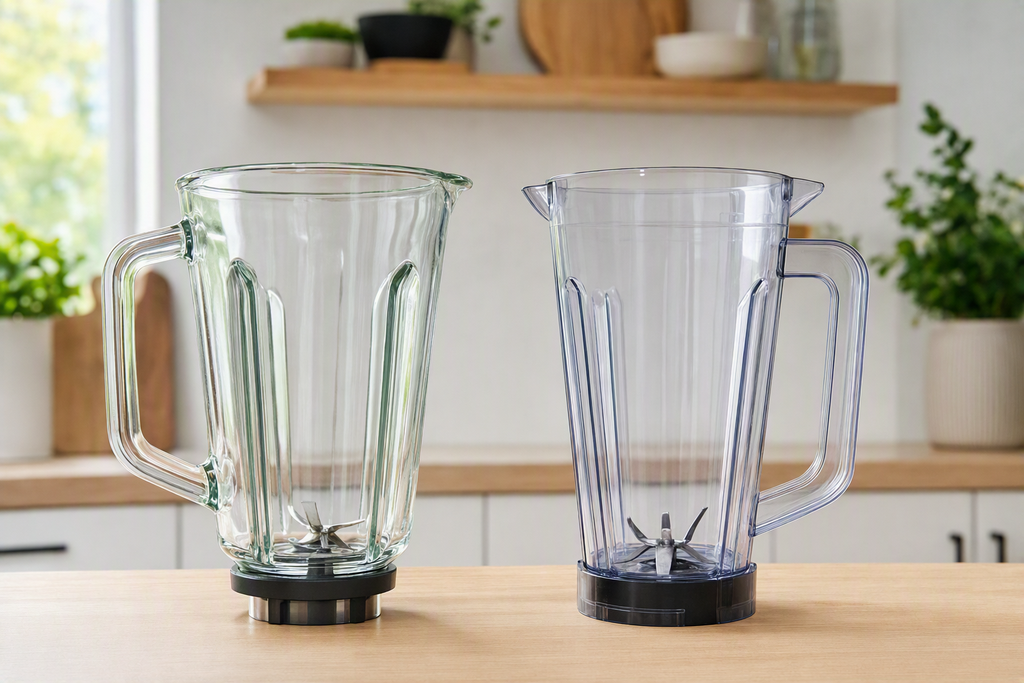
- Tritan Co-Polyester: Lightweight, shatterproof, and resistant to high impact. It is the industry standard for high-wattage blenders because heavy glass risks fracturing under extreme torque.
- Tempered Glass: Resists clouding, discoloration, and scratching from hard ingredients like frozen fruits or nut shells. However, glass is significantly heavier and vulnerable to thermal shock or impact damage.
- Stainless Steel: Provides optimal temperature retention, complete light blockage, and unmatched structural durability. Its main drawback is opacity, which prevents monitoring vortex movement during blending.
Cleanability is also governed by food safety standards established by organizations like NSF International safety standards, ensuring container materials remain non-porous and free from chemical leaching under repeated friction heat.
Managing Decibels and Kitchen Acoustics
High-wattage motors rotating blades at extreme velocities generate substantial sound levels, frequently exceeding 88 decibels. According to Centers for Disease Control and Prevention guidelines on sound safety, exposure to noise above 85 decibels over extended periods can cause hearing strain, making acoustic control an important home comfort metric.
Noise output depends on housing insulation, rubber motor mounts, and air vent design. Sound enclosures—acrylic shields that cover the entire blending jar—reduce noise by 10 to 15 decibels, lowering sound levels to a comfortable background hum.
Key Takeaways
- Higher wattage maintains blade speed, preventing thermal breakdown of cold ingredients during long blends.
- Tritan plastic jars withstand high torque safer than glass, while glass resists cosmetic scratching.
- Sound shields lower blending volume significantly for quiet morning routines.
| Blender Category | Motor Wattage | Best Jar Material | Avg Noise Level |
|---|---|---|---|
| Personal / Single-Serve | 600W – 900W | Tritan Plastic | 80 – 85 dB |
| Standard Family Size | 1,000W – 1,200W | Glass or Tritan | 85 – 90 dB |
| High-Performance Commercial | 1,400W – 1,800W+ | Heavy-Duty Tritan | 88 – 95 dB (75 dB w/ Shield) |
Matching Specifications to Your Smoothie Ingredients
Choosing the correct specifications comes down to your primary smoothie ingredients. Light fruit blends require far less mechanical energy than recipes heavy in seeds, raw fibrous vegetables, or ice blocks.
If your daily recipe relies heavily on chia seeds, blackberry seeds, or fibrous celery, prioritize high tip-speed velocity and wing-tip blade designs. For simple protein powders, bananas, and milk bases, lower wattage units perform reliably without unnecessary energy consumption.
Maintenance Best Practices to Prevent Motor Burnout
Blender failure usually occurs from seal degradation, drive socket wear, or electrical overheating. Running a high-speed blender continuously for over two minutes without liquid creates air resistance that overworks the motor drive belt.
Always load liquids first, followed by fresh produce, leafy greens, and frozen items on top. This sequence ensures immediate blade contact with liquid, establishing a continuous vortex without putting excessive initial load on the motor bearings.
Bottom Line
- Select a 1,200W+ motor if processing raw green fibers, frozen fruit, and seeds daily.
- Opt for impact-resistant Tritan jars on high-velocity blenders to ensure structural safety.
- Load liquids first to establish proper vortex circulation and prolong motor lifespan.
Frequently Asked Questions
Is a higher wattage blender always better for smoothies?
Higher wattage provides greater torque and speed retention under heavy load, ensuring smooth processing of frozen fruits and fibrous greens. However, wattage alone does not guarantee quality; blade design and jar geometry are equally vital.
Why does my blender smell like burning rubber during use?
A burning smell typically indicates motor strain or drive socket friction. This occurs when blending dense mixtures without adequate liquid or running the motor continuously at low speeds under high resistance.
Are glass blender jars safer than Tritan plastic jars?
Both materials are food-safe. Tempered glass resists scratches and odors but is heavy and prone to breaking if dropped. Tritan plastic is shatterproof, lightweight, and BPA-free, making it the preferred choice for high-speed blenders.
How can I reduce the noise level of my countertop blender?
Placing a silicone dampening mat under the blender base absorbs acoustic vibrations transmitted through countertops. Alternatively, choosing a blender with a dedicated acrylic sound enclosure significantly reduces decibel output.
What is cavitation in a smoothie blender?
Cavitation occurs when an air pocket forms around the spinning blades, preventing ingredients from dropping into the cutter assembly. Adding more liquid or using a tamper tool breaks the air cavity to restore vortex flow.
Do dull blades really work better than sharp blades?
In high-speed countertop blenders, thick, blunt stainless steel blades pulverize tough ingredients through high kinetic velocity rather than cutting, providing long-term durability without dulled edge performance.