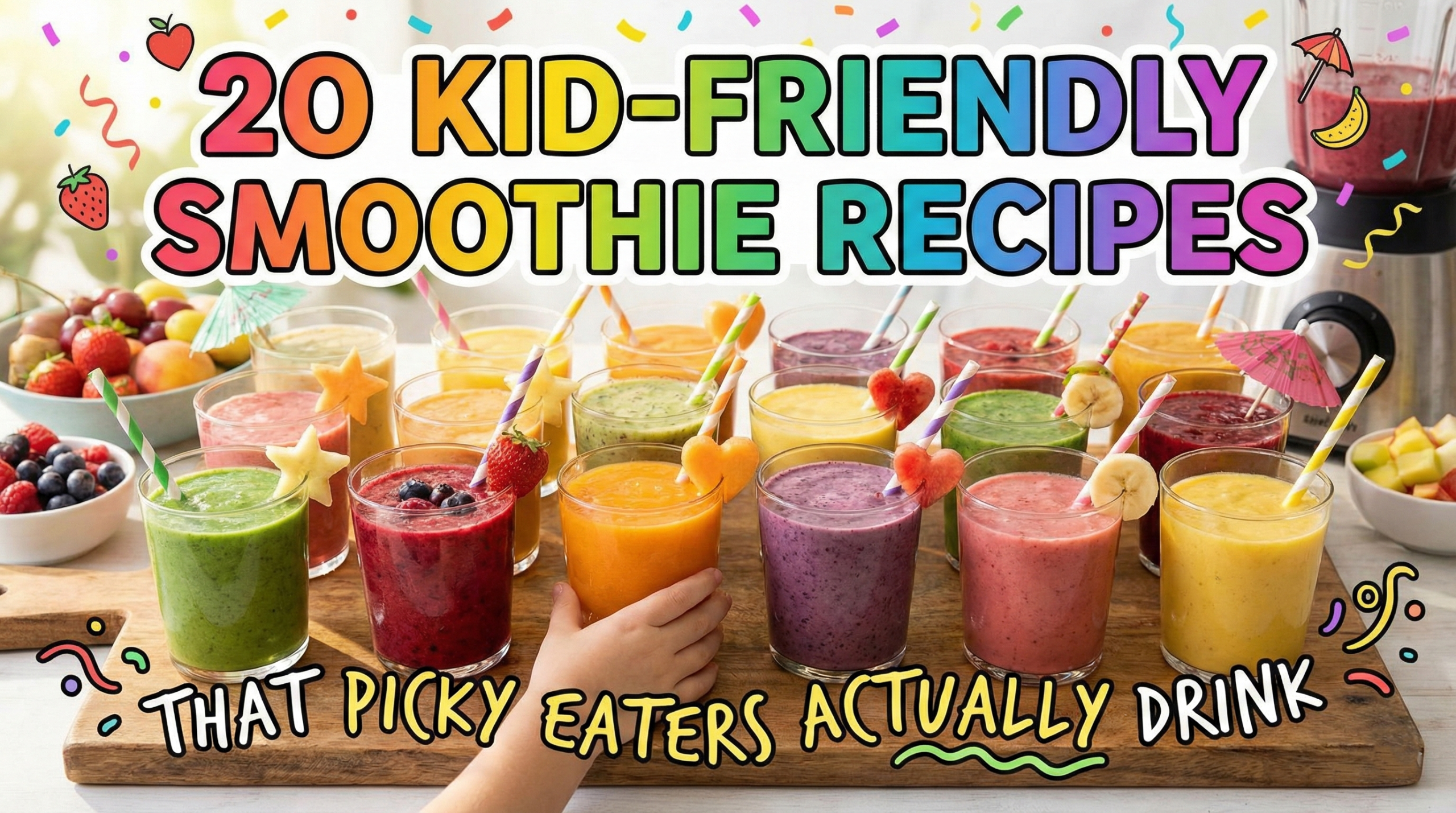
20 Kid-Friendly Smoothie Recipes That Picky Eaters Actually Drink
Parents looking for kid friendly smoothie recipes face a unique challenge: what’s nutritious doesn’t always match what children willingly consume. The gap between pediatric nutrition guidelines and actual consumption patterns creates real frustration in kitchens across the country. This guide examines 20 recipe frameworks that consistently perform with reluctant drinkers, organized by the specific resistance patterns they overcome.
The recipes ahead address texture aversions, color prejudices, and the fundamental distrust many children develop toward “healthy” drinks. Each category reflects observational patterns from parents who’ve navigated years of breakfast negotiations. What follows isn’t aspirational—it’s what actually gets finished.
Before diving into specific recipes, understand that kid-friendly smoothie success depends less on ingredient perfection and more on matching the drink to your child’s current tolerance level. A five-year-old who rejects anything green operates under different constraints than a twelve-year-old athlete seeking post-practice recovery. The recipes here acknowledge those differences without judgment.
What Defines a Kid-Friendly Smoothie?
The term “kid-friendly” in smoothie contexts refers to drinks that balance nutritional adequacy with palatability factors children actually respond to. This balance shifts dramatically across age groups and individual preferences.
Sweetness level matters more than most nutrition-focused parents initially accept. Children possess approximately 30% more taste buds than adults, with heightened sensitivity to bitter compounds found in many vegetables and whole fruits. Recipe frameworks that ignore this biological reality typically fail regardless of nutritional profile.
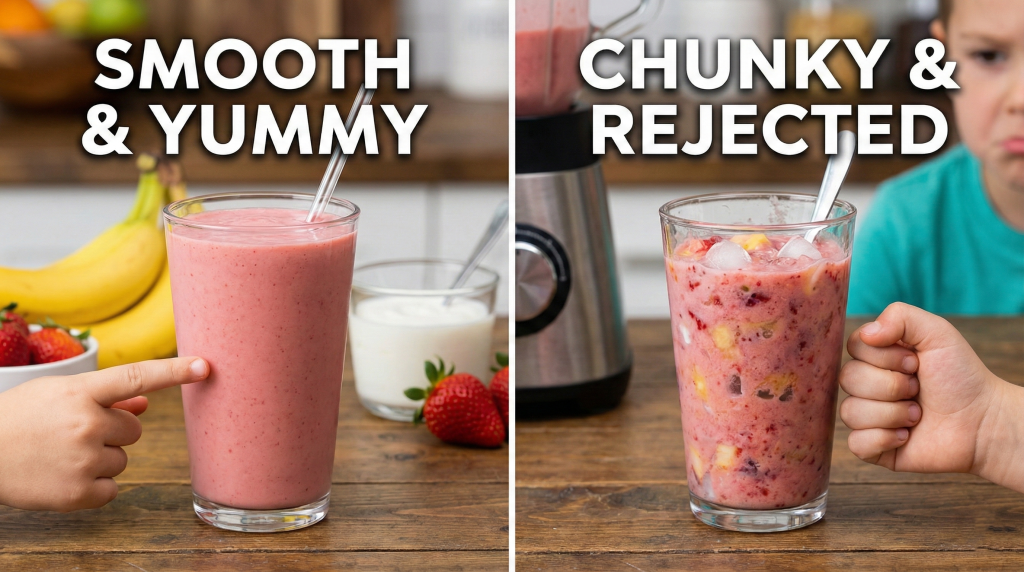
Texture creates the second major acceptance barrier. Smoothies with visible seeds, fibrous chunks, or separation layers trigger immediate rejection in many children. The drink must present as uniform and predictable—characteristics that reassure rather than challenge.
Color psychology influences acceptance rates more than most parents expect. Brown or murky green smoothies face uphill battles, while pink, purple, and orange variations receive more willing trial. This isn’t about deception—it’s about removing unnecessary resistance points while the child develops broader acceptance.
Temperature preference varies widely. Some children prefer slightly frozen, almost milkshake-like consistency, while others reject anything that causes brain freeze. Most recipes perform better when served cold but not icy, allowing flavor to register without temperature discomfort.
Quick Summary:
- Biological differences make children more sensitive to bitterness and texture irregularities
- Visual uniformity and familiar colors reduce initial resistance
- Temperature and sweetness level require individual calibration
- Success metrics focus on completion rather than immediate enthusiasm
Why Traditional “Healthy” Drinks Fail With Children
Children reject health-forward smoothies for reasons that make complete sense from their perspective. Understanding these resistance mechanisms prevents the recipe frustration cycle many parents experience.
The bitter compound problem sits at the core. Leafy greens, unsweetened cocoa, and certain berries contain naturally occurring bitter notes that children’s heightened taste sensitivity amplifies. Adults perceive these as mild background flavors; children experience them as dominant and unpleasant.
Visible vegetable pieces trigger categorical rejection in picky eaters. A child who refuses cooked broccoli won’t suddenly accept it blended into a drink. The texture may change, but the recognition remains. Recipes that attempt to “hide” vegetables through inadequate blending fail immediately.
Consistency expectations matter. Children generally prefer thicker, more milkshake-like textures over thin, juice-like consistency. Watery smoothies feel incomplete and unsatisfying, often leading to partial consumption regardless of flavor quality.
The “this is good for you” pitch actively backfires. Research from Cornell University’s Food and Brand Lab demonstrates that health-focused messaging reduces children’s willingness to try new foods. Framing a smoothie as healthy creates suspicion rather than interest.
Unpredictability breeds resistance. If Tuesday’s smoothie tasted completely different from Monday’s despite similar appearance, children develop wariness toward all smoothies. Consistency in recipe execution matters more than variety in early acceptance stages.
Key Takeaways:
- Health messaging reduces rather than increases acceptance in children
- Texture and visibility problems can’t be solved through persuasion
- Bitter sensitivity is biological, not behavioral
- Recipe consistency builds trust faster than variety
Foundational Nutrition Considerations
Parents building smoothie routines for children need clarity on what actually matters nutritionally versus what constitutes marketing noise.
Fruit sugar concerns require context. A smoothie containing whole fruit provides fiber, vitamins, and minerals alongside natural sugars. This differs fundamentally from drinks with added refined sugars. The USDA Dietary Guidelines distinguish between intrinsic and added sugars for this reason—the nutritional package matters.
Protein inclusion helps stabilize blood sugar response and extends satiety, particularly important for breakfast smoothies. Greek yogurt, nut butters, and certain plant-based proteins serve this function without requiring protein powder products. Most children receive adequate protein from whole food sources.
Calcium density matters during growth periods. Dairy-based smoothies naturally provide significant calcium, while plant-based versions require fortified ingredients or additional calcium sources. This isn’t about superiority—it’s about meeting documented mineral needs during bone development phases.
Vitamin C absorption improves iron uptake from plant sources. Pairing citrus fruits or berries with spinach-based smoothies provides functional benefit beyond individual nutrient content. This combination strategy works better than isolated supplementation for most children.
Fiber content requires balance. Too little fails to support digestive regularity; too much can cause discomfort in children with sensitive systems. Whole fruits and vegetables provide moderate, well-tolerated fiber levels without requiring added supplements.
The American Academy of Pediatrics recommends limiting fruit juice to 4-6 ounces daily for children ages 1-6, expanding to 8-12 ounces for older children. Smoothies made from whole fruit fall into a different category but should still represent one daily serving rather than unlimited consumption.
In Short:
- Natural fruit sugars accompanied by fiber differ from added sugars
- Protein and calcium needs vary by age and dietary pattern
- Portion control matters even with nutritious ingredients
- Whole food sources generally outperform isolated supplements
The Vegetable Integration Strategy
Getting vegetables into children’s diets through smoothies works when execution accounts for taste biology rather than fighting it.
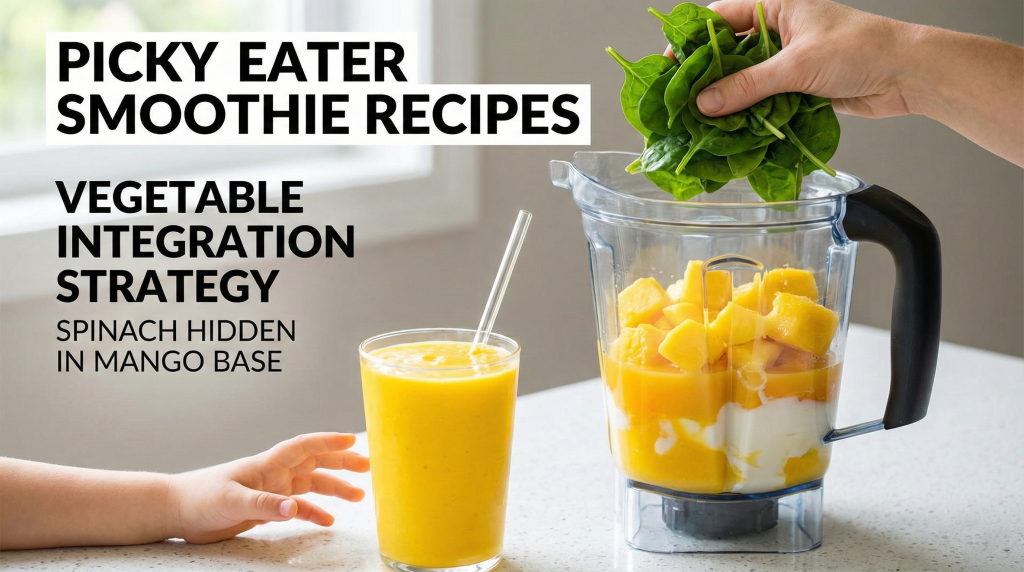
Spinach serves as the primary stealth vegetable because it carries minimal flavor when fresh and blends completely smooth. Baby spinach works better than mature leaves, which can introduce slight bitterness. One cup of raw spinach provides negligible flavor impact when paired with frozen mango or pineapple.
The sweetness ratio determines success. For every cup of greens, most children require at least one cup of naturally sweet fruit to mask any residual vegetable taste. Bananas, mangoes, and pineapples provide the strongest masking effect. Berries work but require larger volumes to achieve the same sweetness level.
Frozen fruit creates better texture than fresh for vegetable-containing smoothies. The thickness masks any textural irregularity from greens while improving the overall mouthfeel children prefer. This isn’t about deception—it’s about removing friction points.
Avocado adds creaminess without flavor dominance, making smoothies feel more substantial. Half an avocado blends invisibly into berry or tropical fruit bases while providing healthy fats that improve nutrient absorption and extend satiety.
Carrots require careful handling. They blend well with orange-flavored bases (mango, orange juice, peach) but introduce vegetable flavor more readily than spinach. Start with small amounts—one small carrot or less—and increase gradually as acceptance builds.
Cucumber works surprisingly well in fruit-forward smoothies, adding hydration and volume without significant flavor contribution. Its mild nature makes it ideal for children extremely sensitive to vegetable tastes.
The color masking hierarchy matters: purple berries mask green spinach, orange mango masks orange carrots, and white banana masks nearly everything. Choose fruit colors that obscure rather than reveal vegetable presence.
Bottom Line:
- Spinach provides the easiest vegetable entry point
- Sweet fruit ratio must exceed vegetable volume significantly
- Frozen fruit improves texture masking capability
- Color coordination reduces visual resistance
20 Recipe Categories That Consistently Perform
These recipe frameworks represent patterns that work across different households and child temperaments. Each category addresses specific acceptance barriers while maintaining nutritional adequacy.
Berry-Based Foundations (Recipes 1-4)
Strawberry banana combinations dominate early smoothie acceptance because both ingredients register as familiar and safe. Frozen strawberries with one banana, orange juice, and optional yogurt creates reliable palatability. The pink color appeals broadly, and texture variation stays minimal.
Blueberry smoothies require sweetness support. One cup frozen blueberries, one banana, half cup apple juice, and yogurt produces the sweetness level most children accept. Without banana, blueberries taste too tart for many young palates.
Mixed berry versions allow flexibility while maintaining the purple-pink color range children recognize as fruit-forward. Equal parts strawberries, blueberries, and raspberries with banana and liquid base works consistently. Blackberries introduce seeds that some children reject.
Berry oat smoothies add staying power for breakfast contexts. Rolled oats blended with berries, banana, and milk create thickness that satisfies longer than fruit-only versions. This works best for children who’ve already accepted berry smoothies and won’t reject the subtle texture shift.
Tropical Fruit Variations (Recipes 5-8)
Mango smoothies deliver intense sweetness that masks nearly any addition. Frozen mango, banana, orange juice, and optional yogurt creates the foundation. Spinach hides easily in this base—start with one cup and increase as tolerance builds.
Pineapple banana combinations provide natural tartness children generally accept. The brightness cuts through dairy richness without tasting medicinal. This category works well for children who find berry smoothies too sweet.
Tropical green smoothies leverage mango or pineapple to hide kale or spinach. The formula: two cups frozen tropical fruit, one cup greens, one banana, and coconut water or orange juice. The vibrant color distracts from vegetable content.
Coconut-based tropical versions work for dairy-sensitive children. Coconut yogurt or coconut milk provides creaminess without the milk proteins some children react to. Pair with mango, pineapple, or passion fruit for flavor compatibility.
Chocolate and Nut Butter Options (Recipes 9-12)
Peanut butter banana smoothies satisfy children who prefer savory-sweet combinations. Two tablespoons peanut butter, one banana, milk, and optional cocoa powder creates milkshake-like appeal. The protein content makes this suitable for post-activity recovery.
Chocolate protein smoothies work for older children and teens seeking performance support. Cocoa powder (not hot chocolate mix), banana, milk, and nut butter provides legitimate nutrition without powder products. Greek yogurt boosts protein further if needed.
Almond butter variations serve peanut-allergic households. The flavor profile stays similar enough that most children don’t resist the swap. Almond butter blends slightly thinner than peanut butter—adjust liquid accordingly.
Hazelnut chocolate combinations appeal to children who like Nutella flavors. Cocoa powder, banana, hazelnut butter, and milk create familiar taste territory. This category skews sweet but provides legitimate nutritional value through nut fats and potassium.
Citrus and Stone Fruit Combinations (Recipes 13-16)
Orange carrot smoothies require sweetness calibration. One orange, one small carrot, banana, and ginger (tiny amount) creates morning-appropriate brightness. The orange color makes carrots invisible. Too much ginger becomes spicy—start with quarter teaspoon.
Peach smoothies work during summer when fresh or frozen peaches provide peak sweetness. Peaches, banana, yogurt, and orange juice creates mild, non-threatening flavor. This category introduces children to stone fruit acceptance.
Cherry smoothies appeal visually but require pit removal attention. Frozen pitted cherries, banana, yogurt, and vanilla extract creates the flavor profile. Some children reject cherry texture—blend thoroughly.
Mango lassi adaptations introduce cardamom gently. Mango, yogurt, lime juice, honey, and minimal cardamom creates culturally broader flavor exposure. This works for children ready to move beyond basic sweetness.
Green Integration and Vegetable-Forward (Recipes 17-20)
Spinach pineapple smoothies serve as vegetable introduction. Two cups frozen pineapple, one cup spinach, banana, and coconut water hides greens completely. The bright yellow-green color looks intentional rather than accidental.
Avocado berry smoothies provide healthy fats without flavor dominance. Half avocado, mixed berries, banana, and milk creates creaminess children recognize as positive. The purple color masks green avocado.
Cucumber melon smoothies work for hydration-focused needs. Cucumber, honeydew or cantaloupe, lime juice, and mint (minimal) creates refreshing summer options. This skews older children who accept less sweet profiles.
Watermelon smoothies require minimal ingredients because watermelon provides sufficient sweetness and volume. Watermelon, banana, and lime juice creates light, hydrating options. Some children reject watermelon seeds—strain if necessary.
What This Means:
- Berry bases provide safest entry points for hesitant children
- Tropical fruits mask vegetables most effectively
- Chocolate and nut butter options satisfy older children seeking substance
- Citrus and stone fruits expand flavor tolerance gradually
- Green smoothies work only after sweetness ratios prove themselves
Age-Appropriate Adjustments
Children’s nutritional needs and taste acceptance evolve significantly across developmental stages. Recipe modifications should account for these shifts.
Toddlers (1-3 years) require texture consistency above all else. Thinner smoothies work better than thick versions that require prolonged chewing. Avoid whole nuts, large seeds, or fibrous elements that pose choking risks. Single-fruit smoothies often perform better than complex flavor combinations.
Preschoolers (3-5 years) begin accepting slightly more complex flavors but still prefer sweet-dominant profiles. This age group responds well to color variety and naming strategies—calling a smoothie “purple power” creates more interest than “blueberry banana.” Portion sizes should stay around 6-8 ounces.
Early elementary (6-8 years) children can handle more adventurous combinations, including mild greens and subtle spices. Peer influence becomes significant—if friends drink green smoothies, resistance drops. This age group often enjoys participation in smoothie creation.
Tweens (9-12 years) start caring about nutritional content beyond taste, particularly if involved in sports or activities. They’ll accept less sweet profiles and can articulate texture preferences clearly. Portion sizes can expand to 10-12 ounces if replacing meals.
Teenagers have adult-like taste acceptance but may resist anything perceived as “childish.” Reframing smoothies as performance nutrition or convenient meal replacement works better than health messaging. They often prefer thicker, more substantial versions with protein emphasis.
Key Takeaways:
- Texture safety matters more than flavor complexity for youngest children
- Color and naming strategies peak in effectiveness during preschool years
- Peer influence and activity participation drive tween acceptance
- Teenagers respond to autonomy and performance framing
- Portion sizes should scale with age and meal replacement intent
Common Execution Mistakes
Even well-designed recipes fail when preparation overlooks practical realities of what children actually consume.
Over-blending creates foamy, aerated texture many children reject. Blend just until smooth—typically 30-45 seconds with a high-powered blender. Extended blending incorporates air, changing mouthfeel in ways that reduce appeal.
Under-blending leaves fibrous bits that trigger immediate rejection. Leafy greens must reach complete liquefaction. If you can see green flecks, it needs more blending. This matters particularly with vegetables.
Temperature extremes reduce flavor perception. Frozen-solid smoothies numb taste buds, making children uncertain about what they’re drinking. Let heavily frozen smoothies sit 2-3 minutes before serving. Room temperature smoothies often taste strange to children expecting cold.
Inconsistent preparation between batches creates trust problems. If Monday’s “strawberry smoothie” tastes different from Wednesday’s despite using the same name, children develop wariness. Measure consistently or accept that children will notice variations.
Forced consumption backfires universally. Requiring a child to finish a smoothie they clearly dislike creates negative associations that extend beyond that specific recipe. Better to accept partial consumption and adjust next time.
Substitution without testing fails frequently. Swapping yogurt types, changing fruit brands, or altering liquid bases can shift flavor and texture enough to trigger rejection. Test substitutions yourself before serving to children.
In Short:
- Blending duration dramatically affects texture acceptance
- Temperature impacts both safety perception and flavor recognition
- Batch consistency builds trust faster than variety
- Forced consumption creates lasting negative associations
Portion Guidelines and Frequency Limits
Even nutritionally sound smoothies require consumption boundaries that many parents overlook initially.
The American Academy of Pediatrics recommends treating smoothies as food rather than beverages, counting them toward daily fruit servings rather than separate hydration. A 6-8 ounce smoothie represents 1-2 servings of fruit depending on composition.
Maximum daily smoothie intake should stay around 8 ounces for young children (under 6 years) and 12 ounces for older children unless specifically replacing a meal. Unlimited smoothie access, even with healthy ingredients, can displace other necessary food groups.
Timing matters for digestive comfort. Smoothies work better as breakfast components or post-activity recovery than as dinner replacements for most children. The liquid volume and quick digestion don’t provide the satiety most children need for overnight fasting.
Frequency should allow for dietary variety. Daily smoothies may crowd out other important foods—whole fruits provide chewing practice and fiber benefits smoothies don’t replicate. Alternating smoothie days with whole fruit days maintains broader nutritional exposure.
The USDA MyPlate guidelines suggest children ages 2-8 need 1-1.5 cups of fruit daily, while older children need 1.5-2 cups. One smoothie can meet or exceed these recommendations, making additional fruit juice or sweetened beverages redundant.
Sugar content accumulates quickly even from whole fruits. A smoothie containing banana, mango, berries, and orange juice may deliver 30-40 grams of natural sugar—comparable to soda’s sugar content despite superior nutritional profile. This matters for children with blood sugar regulation concerns.
Bottom Line:
- Treat smoothies as food servings, not unlimited beverages
- Age-appropriate portion sizes prevent overconsumption
- Daily smoothies may reduce dietary variety unintentionally
- Natural fruit sugar still impacts total daily sugar intake
Building Flavor Complexity Over Time
Children who start with basic fruit smoothies can gradually develop broader acceptance through strategic flavor progression.
Start with single-fruit simplicity. Banana-only or strawberry-only smoothies with milk establish baseline acceptance without complexity. This creates the reference point from which more adventurous combinations grow.
Add secondary fruits in small ratios. Once banana smoothies succeed consistently, introduce berries at 1:3 ratio (one part berry to three parts banana). This gradual shift prevents rejection while expanding flavor territory.
Introduce vegetables through color-compatible combinations. Spinach appears first in mango smoothies, not strawberry. Carrots blend into orange-based smoothies. This visual logic reduces suspicion.
Mild spices enter last and minimally. Cinnamon, vanilla extract, or tiny amounts of ginger add dimension without dominance. Quarter teaspoon amounts let children encounter complexity without overwhelm.
Texture progression moves from thin to thick. Children accepting juice-like smoothies can gradually handle creamier, more substantial versions as expectations adjust. This typically takes several weeks of consistent exposure.
The exposure timeline matters more than daily variety. Serving the same successful smoothie recipe five days straight builds stronger acceptance than five different recipes in five days. Predictability establishes trust.
What This Means:
- Flavor complexity requires sequential introduction, not simultaneous deployment
- Visual logic reduces resistance to vegetable additions
- Minimal spice amounts provide exposure without rejection risk
- Repetition builds acceptance more effectively than variety
When Smoothies Don’t Work
Some children won’t accept smoothies regardless of recipe optimization, and forcing the issue creates more problems than it solves.
Texture sensitivity disorders exist beyond typical pickiness. Children with sensory processing challenges may genuinely experience smoothies as overwhelming or aversive. This isn’t behavior—it’s neurological processing difference requiring different nutritional strategies.
Control-seeking children may reject smoothies specifically because parents want them to drink them. This dynamic appears frequently around ages 3-5 and again in early adolescence. Backing off entirely often resolves this faster than persistence.
Previous negative experiences create lasting associations. If a child vomited after drinking a smoothie (for any reason), aversion may persist regardless of subsequent positive experiences. Time and completely different presentation contexts may eventually help.
Some children simply prefer whole foods and find blended textures fundamentally unappealing. This preference deserves respect rather than correction attempts. Whole fruits and vegetables provide nutrition without requiring smoothie acceptance.
Medical conditions including reflux, gastroparesis, or certain metabolic disorders may make cold, dense liquids uncomfortable regardless of ingredients. Consulting pediatricians before pursuing smoothies as nutritional strategy makes sense when underlying health concerns exist.
Cultural unfamiliarity plays a role. Children from households where blended drinks aren’t traditional may resist smoothies as foreign and suspicious. This represents preference rather than deficiency.
Quick Summary:
- Genuine sensory processing differences differ from typical pickiness
- Control dynamics sometimes require strategic retreat
- Previous negative experiences may create permanent aversions
- Whole food preferences deserve respect
- Medical conditions may contraindicate cold, dense liquids
Practical Implementation Framework
Parents ready to begin smoothie integration benefit from structured rather than haphazard approaches.
Start with acceptance assessment. Serve one simple smoothie—banana with milk works universally—and observe response without pressure. This establishes baseline willingness and identifies immediate texture or temperature concerns.
Build recipe rotation slowly. Once one recipe succeeds consistently (5+ successful servings), introduce a second option. Three reliable recipes provide sufficient variety without overwhelming preparation or creating decision fatigue.
Involve children in selection within boundaries. Offering choice between strawberry-banana or mango smoothies provides autonomy without unlimited options. Most children engage more willingly when they participate in decisions.
Prepare in consistent contexts. Morning smoothies become routine faster than random-timing smoothies. Pairing with specific activities (after soccer practice, Saturday breakfast) creates expectation patterns that reduce resistance.
Accept partial success without judgment. If a child drinks half a smoothie, that represents progress rather than failure. Praise effort and willingness while avoiding pressure to finish.
Document what works. Keep notes on which recipes succeed and which fail. Flavor preferences often follow patterns—children who like mango usually accept pineapple, for example. This prevents repeated testing of already-rejected combinations.
Key Takeaways:
- Assessment before commitment prevents wasted effort
- Limited rotation succeeds better than extensive variety
- Bounded choices provide autonomy without chaos
- Consistency in timing builds routine acceptance
- Partial consumption deserves recognition as progress
Kid friendly smoothie recipes work when parents match nutritional goals to children’s actual sensory capabilities rather than fighting biological realities. The 20 recipe categories outlined here represent frameworks that acknowledge bitter sensitivity, texture preferences, and color psychology while delivering genuine nutritional value. Success depends less on perfect ingredients and more on realistic expectations about what children will consistently consume.
Smoothies serve as one nutritional tool among many, not a universal solution. Some children will never enjoy blended drinks, and that’s fine. Others will accept specific smoothie types but reject variations. Both outcomes represent normal range. The goal isn’t converting every child into an enthusiastic smoothie drinker—it’s finding sustainable approaches that work for your specific household without creating daily conflict. Focus on recipes that actually get finished rather than those that sound ideal but sit half-consumed in the refrigerator.