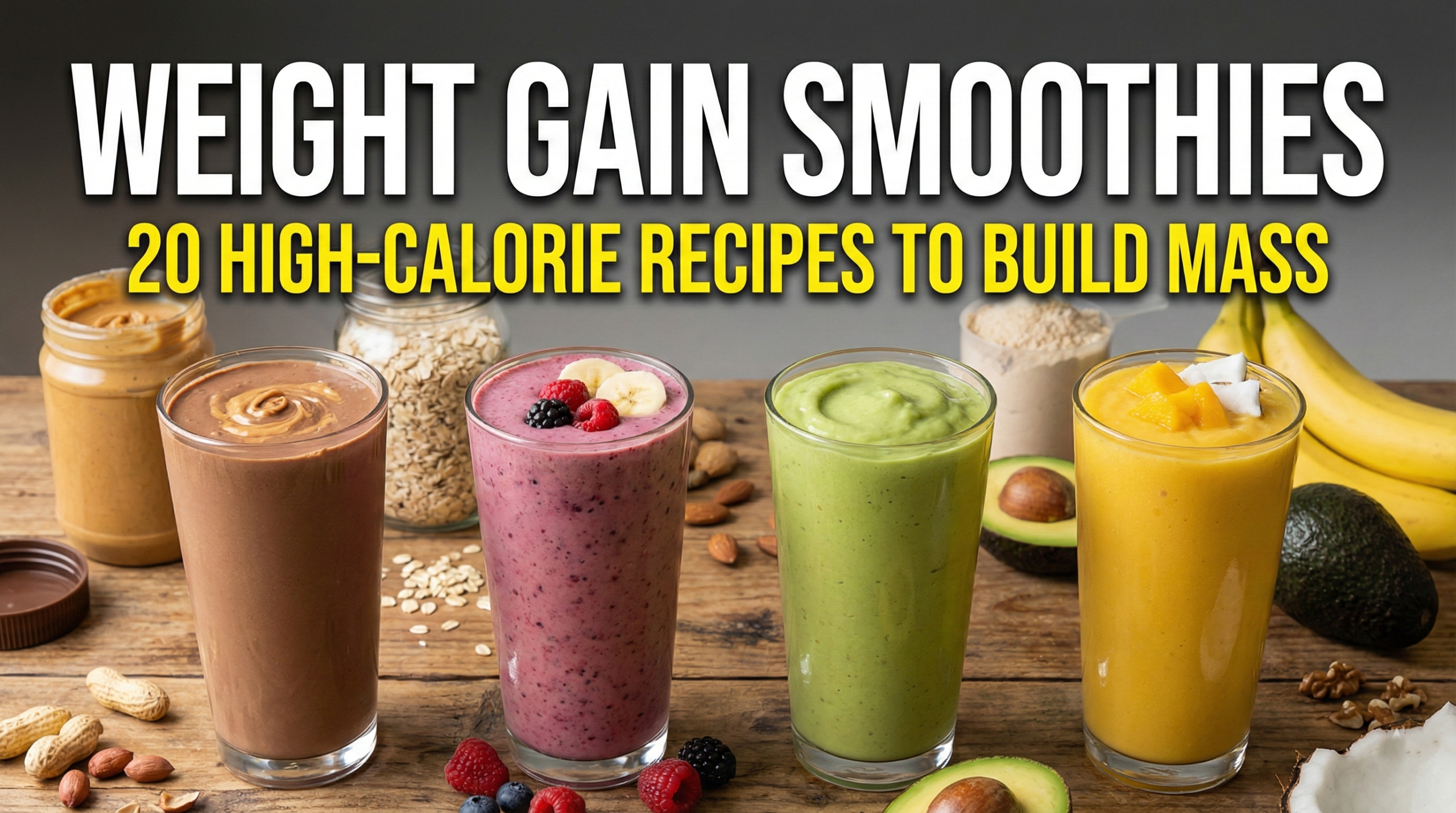
Weight Gain Smoothies: 20 High-Calorie Recipes to Build Mass

Gaining weight through smoothies works when you understand calorie density and ingredient selection. High calorie smoothies for weight gain deliver 500 to 1,200 calories per serving by combining nut butters, oils, whole milk, and dense carbohydrates into drinkable meals that don’t trigger the same fullness response as solid food.
Most people trying to add mass struggle with physical appetite limits. You can only eat so much chicken and rice before satiety hormones shut down hunger. Liquid calories bypass much of that resistance. Your stomach processes smoothies faster than solid meals, leaving you ready to eat again sooner. This creates multiple feeding opportunities throughout the day without constant fullness.
The challenge isn’t finding recipes. It’s understanding which ingredients drive calorie counts up without making smoothies undrinkable, and knowing how to structure daily intake so you’re not replacing meals but adding to them. This guide covers 20 recipes organized by calorie level and purpose, plus the ingredient logic and timing strategies that determine whether weight gain smoothies actually move the scale.
You’ll see why some 1,000-calorie recipes work better post-workout while others function as breakfast replacements, how to customize recipes based on your current weight and activity level, and which common mistakes keep people from seeing results even when they’re drinking these consistently.
What Makes a Smoothie Effective for Weight Gain
Effective weight gain smoothies share three characteristics: calorie density above 400 per serving, macronutrient balance favoring both protein and fats, and ingredient combinations that remain drinkable at high volumes.
Calorie density determines how much energy you pack into each ounce. Water-rich fruits like watermelon or cucumbers dilute calorie content. Dense ingredients like nut butters, coconut oil, and whole milk dairy concentrate calories without adding proportional volume. A tablespoon of peanut butter adds 95 calories. A cup of spinach adds 7 calories. Both occupy different amounts of space in your blender and your stomach.
Macronutrient distribution affects how your body uses those calories. Pure sugar bombs spike insulin and get stored inefficiently. Balanced smoothies with 20-30 grams of protein, 15-25 grams of fat, and 50-80 grams of carbohydrates support muscle synthesis while providing sustained energy. The protein prevents muscle breakdown during calorie surplus periods. The fats slow digestion and provide concentrated calories. The carbohydrates refill glycogen and spare protein for growth rather than energy.
Drinkability matters more than people expect. You can mathematically create a 1,500-calorie smoothie by dumping in six tablespoons of olive oil and four scoops of protein powder, but you won’t finish it. Texture, temperature, and flavor balance determine whether you actually consume the full serving or give up halfway through. Recipes need enough liquid to blend properly, enough sweetness to mask bitter ingredients, and enough variety in texture so every sip doesn’t feel identical.
Quick Summary:
- Calorie density above 400 per serving separates weight gain smoothies from meal replacements
- Balanced macros (protein, fats, carbs) prevent inefficient storage and support muscle growth
- Drinkability determines actual calorie intake more than recipe calorie counts on paper
- Ingredient selection focuses on concentration, not volume
Calorie Math: How High Calorie Smoothies for Weight Gain Work
Weight gain requires consistent caloric surplus above your total daily energy expenditure. The National Institutes of Health estimates that adding 3,500 calories beyond maintenance over time produces approximately one pound of weight gain, though individual response varies based on metabolism, activity, and body composition.
Most adults maintain weight on 1,800 to 2,800 calories daily depending on size, sex, and activity level. Adding one 800-calorie smoothie creates a 800-calorie daily surplus. Over one week, that’s 5,600 excess calories, theoretically producing 1.6 pounds gained. Real-world results typically fall between 0.5 and 1.5 pounds per week when smoothies supplement rather than replace existing meals.
The math changes if smoothies displace food. Drinking a 600-calorie shake instead of a 600-calorie breakfast produces zero net surplus. The surplus only occurs when smoothies add to your total intake. This is why timing matters. Drinking smoothies between meals or immediately post-workout captures surplus potential. Using them to replace meals you’d eat anyway wastes their calorie-loading advantage.
Your maintenance calories shift upward as you gain weight. Someone maintaining 160 pounds on 2,400 calories might need 2,600 calories to maintain 170 pounds. This means your surplus requirement increases over time. What worked to gain your first 10 pounds won’t sustain progress to the next 10 pounds without adjusting portions or frequency.
According to the U.S. Department of Agriculture’s dietary guidelines, healthy weight gain emphasizes nutrient-dense foods over empty calories to support overall health alongside mass building.
In Short:
- 3,500-calorie surplus approximates one pound of gain, though individual response varies
- Smoothies must add to existing intake rather than replace meals to create true surplus
- Maintenance calories increase as body weight increases, requiring ongoing adjustment
- Nutrient density matters for long-term health even during intentional weight gain
Core Ingredients in High Calorie Smoothies for Weight Gain
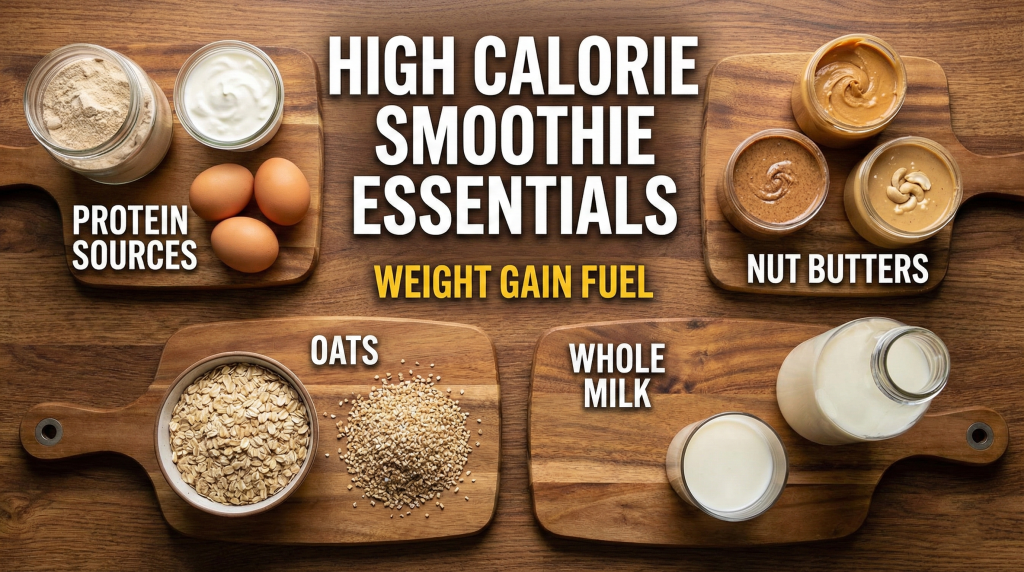
High-calorie smoothies rely on five ingredient categories, each contributing distinct macronutrients and calorie loads. Understanding these categories lets you build custom recipes and troubleshoot why existing recipes might not deliver expected results.
Protein Sources
Protein powder remains the most concentrated option. One scoop of whey isolate adds 25 grams of protein and 120 calories. Mass gainer powders push this to 50 grams of protein and 600+ calories per serving but often include lower-quality carbohydrate sources like maltodextrin. Greek yogurt provides 15-20 grams per cup with additional probiotics. Cottage cheese offers similar protein with different texture. Silken tofu works for plant-based builds, delivering 10 grams per half cup with neutral flavor.
Fat Sources
Nut butters lead this category. Peanut butter, almond butter, and cashew butter each provide roughly 95 calories per tablespoon, split between protein and fat. Coconut oil adds pure fat at 120 calories per tablespoon with medium-chain triglycerides that digest differently than long-chain fats. Avocado contributes healthy fats plus fiber, averaging 240 calories per whole fruit. Heavy cream delivers 52 calories per tablespoon with saturated fat that increases calorie density without much volume.
Carbohydrate Sources
Oats add complex carbohydrates and fiber. One-third cup provides 100 calories and creates creamy texture when blended. Bananas offer quick-digesting carbs at 105 calories per medium fruit plus potassium. Dates concentrate sugar naturally, with two Medjool dates adding 130 calories. Honey provides 64 calories per tablespoon as simple sugars for immediate energy. Sweet potato works surprisingly well blended, offering 112 calories per half cup with beta-carotene.
Liquid Bases
Whole milk provides protein, fat, and carbohydrates at 150 calories per cup. Coconut milk from a can delivers 450 calories per cup through concentrated fat, though it’s thick and needs dilution. Oat milk adds 120 calories per cup with fiber. Almond milk provides minimal calories (30-60 per cup) and works better as a dilution agent than calorie contributor. Fruit juice concentrates sugar, with orange juice adding 110 calories per cup.
Flavor and Functional Additions
Cocoa powder adds antioxidants and chocolate flavor at 12 calories per tablespoon. Cinnamon, vanilla extract, and nutmeg enhance taste without meaningful calories. Spinach and kale add micronutrients at negligible calorie cost. Chia seeds contribute omega-3s and 60 calories per tablespoon. Ground flaxseed offers similar benefits. MCT oil provides easily-absorbed fats at 115 calories per tablespoon for those who tolerate it.
The combination determines final calorie count and macronutrient split. Two tablespoons of peanut butter, one banana, one cup of whole milk, and one scoop of whey creates a roughly 550-calorie smoothie. Swap whole milk for coconut milk and add one tablespoon of coconut oil, and that same recipe jumps to 780 calories.
Key Takeaways:
- Five core categories cover protein, fats, carbs, liquids, and functional additions
- Nut butters and oils drive calorie density more efficiently than volume-based ingredients
- Liquid base selection dramatically affects final calorie count without changing satiety
- Combining categories strategically produces target calorie ranges while maintaining balance
20 High-Calorie Smoothie Recipes for Weight Gain
These recipes organize by calorie range, each designed for specific timing or goals. Calorie counts assume exact measurements. Variations in ingredient brands and blending thoroughness affect final numbers by roughly 5-10%.
500-700 Calorie Range: Foundation Smoothies
1. Classic Banana Peanut Butter (520 calories)
Two medium bananas, two tablespoons peanut butter, one cup whole milk, half scoop vanilla whey protein. This baseline recipe balances all three macros. The bananas provide quick carbs and potassium. Peanut butter adds fats and secondary protein. Whole milk rounds out the base. Works well as a between-meal addition or light post-workout option.
Approximate macros: 30g protein, 18g fat, 62g carbs. Best served cold. Thickness adjusts with milk quantity.
2. Chocolate Oat Mass Builder (580 calories)
One-third cup rolled oats, one banana, two tablespoons cocoa powder, two tablespoons almond butter, one cup whole milk, one scoop chocolate protein powder. The oats add fiber and slow-release carbs. Cocoa provides antioxidants and chocolate flavor without sugar. Almond butter contributes healthy fats. This smoothie feels more substantial than its calorie count suggests due to oat viscosity.
Approximate macros: 35g protein, 20g fat, 65g carbs. Blend oats first to prevent grainy texture.
3. Berry Coconut Gainer (620 calories)
One cup mixed frozen berries, half cup coconut milk (canned), half cup whole milk, one tablespoon honey, two tablespoons cashew butter, one scoop vanilla whey. Frozen berries create thick texture and add antioxidants. Coconut milk pushes calorie density up significantly. Cashew butter provides creamy flavor distinct from peanut or almond. Honey sweetens naturally.
Approximate macros: 32g protein, 28g fat, 58g carbs. The coconut fat content makes this filling despite moderate calories.
4. Tropical Avocado Blend (650 calories)
Half ripe avocado, one cup mango chunks, one banana, one cup whole milk, one tablespoon chia seeds, half scoop vanilla protein. Avocado adds healthy fats and creates ultra-smooth texture. Mango provides tropical sweetness and vitamin C. Chia seeds contribute omega-3s and thickening properties. This recipe masks avocado flavor almost completely.
Approximate macros: 28g protein, 26g fat, 70g carbs. Let avocado ripen fully or the smoothie tastes grassy.
5. Maple Pecan Power (680 calories)
One-third cup pecans, two tablespoons maple syrup, one banana, one cup whole milk, one scoop vanilla whey, pinch of cinnamon. Pecans deliver concentrated fat calories. Maple syrup adds natural sweetness with minerals. Cinnamon enhances flavor complexity. This recipe demonstrates how nuts drive calories up efficiently compared to seeds or dried fruits.
Approximate macros: 33g protein, 32g fat, 64g carbs. Pecans blend better soaked in milk for 10 minutes first.
700-900 Calorie Range: Standard Mass Gainers
6. Peanut Butter Cup Gainer (750 calories)
Three tablespoons peanut butter, two tablespoons cocoa powder, one banana, one-third cup oats, one and a half cups whole milk, one scoop chocolate whey. This hits the sweet spot between drinkability and calorie density. Three tablespoons of peanut butter adds serious fat calories without overwhelming texture. Oats make it substantial. The chocolate-peanut butter combination masks any protein powder aftertaste.
Approximate macros: 42g protein, 34g fat, 78g carbs. Popular post-workout choice due to protein content.
7. Strawberry Almond Mass (780 calories)
One and a half cups strawberries, three tablespoons almond butter, one-quarter cup rolled oats, one cup whole milk, half cup vanilla Greek yogurt, one tablespoon honey. Strawberries provide vitamin C and natural sweetness. Almond butter offers different micronutrients than peanut butter. Greek yogurt adds protein and probiotics. The combination stays drinkable despite high calorie count.
Approximate macros: 38g protein, 36g fat, 82g carbs. The Greek yogurt makes this thicker than most recipes.
8. Coffee Mocha Bulker (820 calories)
One cup cold brew coffee, two tablespoons cocoa powder, one banana, three tablespoons cashew butter, one cup whole milk, one scoop chocolate protein, one tablespoon MCT oil. The coffee adds caffeine for pre-workout energy. MCT oil provides easily-absorbed fats. Cashew butter creates creamy texture. This works as breakfast replacement or pre-training fuel.
Approximate macros: 40g protein, 42g fat, 70g carbs. Caffeine content makes this unsuitable before bed.
9. Blueberry Oat Supreme (850 calories)
One and a half cups blueberries, half cup rolled oats, two tablespoons almond butter, one tablespoon coconut oil, one cup whole milk, one scoop vanilla whey, two Medjool dates. Blueberries provide antioxidants. Dates add natural concentrated sweetness. Coconut oil pushes calorie density higher. This recipe balances multiple ingredient categories for complete nutrition.
Approximate macros: 38g protein, 38g fat, 92g carbs. The dates must be pitted and soaked briefly for smooth blending.
10. Green Machine Gainer (880 calories)
One cup spinach, one banana, half avocado, two tablespoons peanut butter, one-third cup oats, one cup whole milk, one scoop vanilla protein, one tablespoon ground flaxseed. The spinach adds virtually no calories but provides iron and vitamins. This proves you can make high-calorie smoothies while including vegetables. The other ingredients completely mask spinach flavor.
Approximate macros: 42g protein, 40g fat, 84g carbs. Spinach must blend thoroughly or you’ll have green specks.
900-1,100 Calorie Range: Serious Mass Builders
11. Double Nut Behemoth (920 calories)
Two tablespoons peanut butter, two tablespoons almond butter, one banana, half cup oats, one and a half cups whole milk, one scoop chocolate protein, one tablespoon coconut oil. Combining two nut butters diversifies fat sources and micronutrients. The coconut oil addition pushes this into serious territory. This smoothie requires determined drinking due to density.
Approximate macros: 46g protein, 48g fat, 88g carbs. Blend in intervals to prevent overheating your blender motor.
12. Banana Date Extreme (980 calories)
Two bananas, four Medjool dates, three tablespoons tahini, one-third cup oats, one cup whole milk, one scoop vanilla whey, one tablespoon chia seeds. Tahini provides sesame-based fats distinct from nut butters. Four dates contribute serious sugar calories naturally. This recipe demonstrates how dried fruits concentrate carbohydrates effectively.
Approximate macros: 40g protein, 42g fat, 112g carbs. The date sugar content makes this best post-workout when insulin sensitivity is high.
13. Chocolate Coconut Tsunami (1,020 calories)
One cup canned coconut milk, half cup whole milk, two tablespoons cocoa powder, three tablespoons almond butter, one banana, one scoop chocolate protein, one tablespoon honey. The full-fat canned coconut milk drives calories up dramatically. This recipe shows maximum calorie density while maintaining chocolate-forward flavor. The thickness requires aggressive blending.
Approximate macros: 44g protein, 58g fat, 86g carbs. Refrigerate coconut milk beforehand or it separates during blending.
14. Berry Overload Mass (1,050 calories)
Two cups mixed berries, half cup vanilla Greek yogurt, three tablespoons cashew butter, one-third cup oats, one cup whole milk, one scoop vanilla protein, two tablespoons ground flaxseed. The high berry volume provides antioxidants while cashew butter and flaxseed contribute fats. Greek yogurt adds protein and probiotics. This balances fruit content with serious calorie density.
Approximate macros: 50g protein, 46g fat, 98g carbs. Frozen berries create better texture than fresh for this recipe.
15. Pumpkin Spice Giant (1,080 calories)
Half cup pumpkin puree, three tablespoons almond butter, one banana, one-third cup oats, one and a half cups whole milk, one scoop vanilla protein, one tablespoon maple syrup, pumpkin pie spice. Pumpkin adds fiber and beta-carotene at low calorie cost. The nut butter and milk carry the calorie load. This seasonal flavor profile makes drinking large volumes easier.
Approximate macros: 46g protein, 48g fat, 102g carbs. Use pure pumpkin puree, not pumpkin pie filling which contains added sugar.
1,100+ Calorie Range: Maximum Mass Protocols
16. Peanut Butter Avalanche (1,150 calories)
Four tablespoons peanut butter, two bananas, half cup oats, one and a half cups whole milk, one scoop chocolate protein, one tablespoon MCT oil, two Medjool dates. This represents near-maximum drinkable peanut butter content. The dates add sweetness to balance savory peanut flavor. MCT oil provides additional fats that digest differently than nut fats.
Approximate macros: 48g protein, 56g fat, 118g carbs. The thickness requires dilution for some blenders.
17. Triple Threat Mass (1,200 calories)
Two tablespoons peanut butter, two tablespoons almond butter, two tablespoons tahini, one banana, two-thirds cup oats, one and a half cups whole milk, one scoop vanilla protein, one tablespoon coconut oil. Three different nut/seed butters diversify nutrient profiles. The oat quantity makes this feel like a meal. This recipe pushes upper limits of what remains comfortably drinkable.
Approximate macros: 52g protein, 62g fat, 110g carbs. Best consumed slowly over 15-20 minutes.
18. Coconut Chaos Blend (1,250 calories)
One and a half cups canned coconut milk, half cup whole milk, two tablespoons cocoa powder, three tablespoons cashew butter, one banana, one scoop chocolate protein, one-third cup oats, one tablespoon honey. The coconut milk dominance creates maximum fat calories. This recipe demonstrates how liquid base selection dramatically affects final calorie count. The chocolate flavor helps mask the heavy coconut fat presence.
Approximate macros: 46g protein, 74g fat, 106g carbs. Requires refrigeration and reblending if not consumed within 30 minutes.
19. Sweet Potato Surprise (1,180 calories)
Half cup cooked sweet potato (cooled), three tablespoons almond butter, one banana, one-third cup oats, one and a half cups whole milk, one scoop vanilla protein, two tablespoons maple syrup, cinnamon. Sweet potato adds complex carbs and beta-carotene. The combination tastes like dessert despite vegetable content. This proves unusual ingredients work when balanced correctly.
Approximate macros: 48g protein, 52g fat, 122g carbs. Sweet potato must be fully cooled before blending or texture suffers.
20. Ultimate Mass Protocol (1,320 calories)
Four tablespoons peanut butter, one banana, two-thirds cup oats, one and a half cups whole milk, one and a half scoops chocolate protein, two tablespoons coconut oil, three Medjool dates, one tablespoon chia seeds. This represents maximum practical calorie density while maintaining drinkability. The date sweetness balances the heavy fat content. Protein content supports muscle synthesis during aggressive surplus.
Approximate macros: 58g protein, 64g fat, 128g carbs. Consume post-workout or as meal replacement rather than between-meal addition.
What This Means:
- Recipes organize by calorie range for strategic selection based on timing and goals
- Higher calorie recipes require more careful flavor balancing to remain drinkable
- Ingredient combinations affect texture and satiety independent of calorie count
- Protein content scales with calories to support muscle synthesis during surplus
When to Drink High Calorie Smoothies for Weight Gain
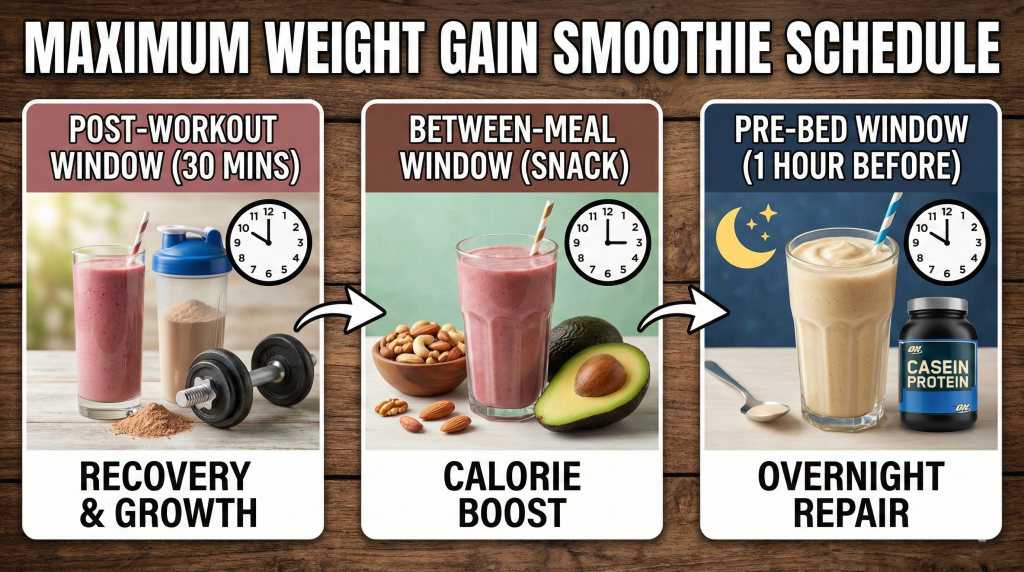
When you drink these smoothies matters as much as what’s in them. Timing affects nutrient absorption, workout performance, and whether calories add to your total or replace existing meals.
Post-Workout Window
The 30-90 minutes after resistance training represents peak nutrient sensitivity. Muscle cells absorb glucose and amino acids more efficiently during this period. High-calorie smoothies consumed post-workout refill glycogen stores and provide protein for muscle synthesis. The National Institutes of Health notes that post-exercise nutrition timing influences muscle recovery and adaptation, though the window may be wider than previously thought.
Recipes in the 700-1,100 calorie range work best here. They provide sufficient protein (35-50 grams) while delivering carbohydrates to restore glycogen. Lower calorie options (500-700) might not create enough surplus. Higher options (1,100+) might cause digestive discomfort if you train intensely.
Between Meals
Mid-morning and mid-afternoon represent ideal windows for calorie addition without meal displacement. These smoothies genuinely add to your total daily intake rather than replacing food you’d eat anyway. The key is timing them far enough from meals that they don’t suppress appetite for your next regular meal.
A 9:00 AM smoothie after 7:00 AM breakfast leaves room for noon lunch. A 3:00 PM smoothie after 12:00 PM lunch doesn’t interfere with 6:00 PM dinner. This spacing maintains your normal eating pattern while adding 500-1,000 calories daily.
Recipes in the 500-800 calorie range prevent excessive fullness that might eliminate your next meal. Higher calorie smoothies work if you’re already comfortable eating large volumes, but most people find moderate smoothies between meals more sustainable long-term.
Before Bed
Evening smoothies take advantage of overnight fasting for nutrient delivery. During sleep, your body enters an anabolic state where growth hormone peaks and protein synthesis occurs. A pre-bed smoothie provides amino acids and energy during this 6-8 hour fasting window.
The challenge is digestive comfort. Lying down with a full stomach causes reflux for some people. Lower-volume, higher-fat smoothies (600-800 calories) work better than massive 1,200-calorie versions. Casein protein instead of whey provides slower digestion. Greek yogurt, cottage cheese, or casein powder creates this effect.
Caffeine-containing recipes obviously don’t work here. Avoid coffee-based smoothies or anything with stimulating ingredients before bed.
Meal Replacement
Using smoothies as meal replacements makes sense when solid food isn’t practical but doesn’t create calorie surplus. If you normally eat a 600-calorie breakfast and replace it with a 600-calorie smoothie, you’ve gained nothing for weight gain purposes. This strategy works for convenience or appetite issues, not mass building.
The exception is when smoothies allow you to consume more calories than you could eat in solid form. If breakfast usually means 500 calories because you’re not hungry in the morning, but you can drink 800 calories, the smoothie creates a 300-calorie surplus over your normal pattern.
Frequency Considerations
One smoothie daily adds 500-1,000 calories consistently. Two smoothies (mid-morning and post-workout) create 1,000-2,000 calorie surplus if timed to avoid meal displacement. Three smoothies typically replace meals rather than adding to them unless you’re already eating 4,000+ calories daily.
Most people see steady progress with one post-workout smoothie (700-900 calories) plus one between-meal smoothie (500-700 calories). This adds 1,200-1,600 calories daily without requiring constant drinking or eliminating solid food meals. The approach remains sustainable for months rather than weeks.
In Short:
- Post-workout timing maximizes nutrient absorption during peak muscle sensitivity
- Between-meal smoothies create true surplus by avoiding meal displacement
- Pre-bed options support overnight anabolism but require digestive comfort consideration
- One to two smoothies daily balances surplus creation with sustainable implementation
Common Mistakes with High Calorie Smoothies for Weight Gain
Weight gain smoothie failures typically follow predictable patterns. These mistakes prevent results even when people follow recipes correctly and drink consistently.
Replacing Instead of Adding
The most common error is using smoothies to replace meals rather than supplement them. If you normally eat breakfast, lunch, and dinner totaling 2,200 calories and replace lunch with a 700-calorie smoothie, you’ve reduced your total intake to 2,100 calories. No weight gain occurs. The smoothie must come in addition to those three meals or at times when you wouldn’t normally eat.
This mistake happens because smoothies feel substantial. After drinking 800 calories, you’re not hungry for your next meal. But if that next meal would have been 600 calories, you’ve only created a 200-calorie surplus instead of the intended 800-calorie addition.
The fix requires honest tracking for one week. Record everything you eat and drink, including smoothies. Calculate your actual total daily calories. If adding smoothies hasn’t increased your total by their calorie content, they’re displacing meals.
Inconsistent Consumption
Drinking smoothies Monday, Wednesday, Friday creates three 800-calorie surplus days and four maintenance days. Weekly surplus totals 2,400 calories, producing roughly 0.7 pounds of gain every seven days. But many people expect faster results from “drinking weight gain shakes” and get discouraged.
Consistency means daily consumption or at minimum six days per week. Missing days doesn’t ruin progress, but irregular patterns prevent the steady surplus needed for reliable weight gain. Your body needs consistent calorie excess to support tissue building rather than sporadic overfeeding followed by deficit days.
Track consumption frequency honestly. If you’re drinking smoothies four days per week instead of seven, that’s why progress stalls. Either commit to daily intake or adjust expectations about gain rate.
Ignoring Liquid Base Impact
Using almond milk instead of whole milk in a recipe drops calories by 110 per cup. Across 20 recipes, that difference determines whether you’re making 600-calorie smoothies or 750-calorie smoothies. Many people select “healthier” milk alternatives without realizing the calorie impact.
For weight gain purposes, whole milk, coconut milk, oat milk, or kefir work better than almond milk, skim milk, or water. The fat content drives calorie density. If you’re lactose intolerant or avoiding dairy, full-fat coconut milk provides similar calorie density. Regular coconut milk from a carton doesn’t work—you need the canned version.
Check your default liquid base and calculate the calorie difference from recipe specifications. If you’ve been using almond milk because it’s “healthier,” that’s likely why results lag expectations.
Over-Blending
Extended blending heats ingredients through friction. Warm smoothies are unpleasant to drink, and heat can denature some proteins and damage temperature-sensitive nutrients. Most recipes need 45-60 seconds of blending maximum. Continuing for 2-3 minutes creates a warm, oxidized mixture that tastes worse than it should.
High-powered blenders accomplish mixing faster than standard models. If you’re using a Vitamix or Blendtec, 30-45 seconds suffices. Standard blenders need 60-90 seconds. Stop when ingredients fully incorporate and texture smooths. Further blending doesn’t improve results.
Neglecting Protein Balance
Some people focus exclusively on calories and create smoothies with 90 grams of carbs, 60 grams of fat, and 15 grams of protein. Weight gain occurs, but muscle building lags. The calorie surplus supports fat gain more than lean mass development.
Each smoothie should contain at least 20-30 grams of protein, preferably 30-40 grams for recipes above 800 calories. This supports muscle protein synthesis during calorie surplus. Without adequate protein, extra calories store primarily as fat rather than supporting muscle growth alongside fat accumulation.
Add protein powder, Greek yogurt, cottage cheese, or additional nut butter if your smoothie’s protein content falls below 20 grams. Don’t sacrifice protein for higher total calories.
Expecting Immediate Results
People drink high-calorie smoothies for three days and check the scale expecting visible change. Weight fluctuates 2-4 pounds daily based on water retention, glycogen storage, and digestive contents. Three days of 800-calorie surplus creates 2,400 excess calories, theoretically producing 0.7 pounds of tissue gain, but daily fluctuations completely mask that change.
Meaningful assessment requires two to four weeks of consistent implementation. Weigh yourself daily at the same time (morning, after bathroom, before eating) and calculate weekly averages. Compare week one’s average to week four’s average. That’s your actual gain rate. Day-to-day changes represent noise, not signal.
Key Takeaways:
- Smoothies must add to total intake rather than replace existing meals to create surplus
- Consistent daily consumption produces steady results versus sporadic drinking
- Liquid base selection dramatically affects calorie density independent of other ingredients
- Protein content determines whether surplus supports muscle growth or pure fat storage
- Meaningful progress assessment requires 2-4 weeks of consistent implementation
Alternative Approaches to High Calorie Smoothies for Weight Gain
Standard smoothie protocols don’t work for everyone. Physical limitations, dietary restrictions, and practical constraints require alternative approaches.
Lactose Intolerance
Whole milk provides convenient protein, fat, and carbs, but lactose intolerant individuals experience digestive distress from dairy-based recipes. Full-fat canned coconut milk offers similar calorie density (450 calories per cup) with no lactose. Oat milk provides 120 calories per cup with fiber. Soy milk delivers protein comparable to dairy milk at 100 calories per cup.
Replacing whole milk with coconut milk in any recipe increases fat content and calories. The trade-off is stronger coconut flavor and thicker texture. Dilute half-and-half with water for similar consistency to whole milk. Oat milk works when you want neutral flavor without fat dominance.
Lactose-free milk exists and contains identical nutrients to regular milk with lactase enzyme added. This sidesteps the issue entirely if coconut flavor doesn’t appeal.
Nut Allergies
Nut butters drive calorie density in most recipes. People with tree nut or peanut allergies lose this entire category. Seed butters (sunflower, pumpkin, tahini) provide similar fat and protein profiles. Sunflower seed butter tastes closest to peanut butter. Tahini offers distinct sesame flavor. Both work in any recipe calling for nut butter.
Coconut butter (not coconut oil) provides another alternative with higher fat content than seed butters. The texture differs—it’s drier and requires more liquid—but calorie density remains high.
Soy nut butter exists for those who tolerate soy but not tree nuts. It mimics peanut butter closely in taste and texture.
Digestive Sensitivity
Some people can’t process 1,000-calorie smoothies in one sitting without bloating or nausea. Their digestive capacity limits liquid volume. Splitting one large smoothie into two smaller servings consumed two hours apart solves this. A 900-calorie recipe becomes two 450-calorie portions.
Alternatively, focus on recipes in the 500-700 calorie range and increase frequency rather than volume per serving. Three 600-calorie smoothies throughout the day (post-workout, mid-morning, pre-bed) total 1,800 calories without requiring massive single servings.
Digestive enzymes like papain or bromelain sometimes help, though effects vary individually. Some people benefit from drinking smoothies at room temperature rather than cold, as extreme cold slows gastric emptying.
Budget Constraints
Protein powder, multiple nut butters, and specialty ingredients create expense. Budget-friendly alternatives exist. Whole milk, peanut butter, bananas, oats, and generic protein powder cost significantly less than boutique ingredients while providing similar macronutrient profiles.
One 5-pound bag of whey concentrate ($40-60) provides 60+ servings. Generic peanut butter costs $6-8 per jar versus $15 for artisanal almond butter. Regular rolled oats cost $4-5 per container that lasts weeks. Frozen bananas prevent waste and cost less than fresh.
A basic budget recipe might be: two tablespoons peanut butter ($0.30), one banana ($0.25), one-third cup oats ($0.15), one cup whole milk ($0.35), one scoop protein ($0.70). That’s $1.75 for a 550-calorie smoothie. Commercial mass gainers cost $3-5 per serving for similar calories.
Training-Day vs. Rest-Day Adjustment
Heavy training days burn additional calories, requiring higher smoothie intake to maintain surplus. Rest days need fewer calories. Some people drink 1,000-calorie smoothies on training days and 600-calorie versions on rest days. This matches energy needs more precisely than fixed daily intake.
The downside is complexity. Tracking different recipes for different days creates more planning overhead. Many people find consistent daily intake simpler even if it means slight overshooting on rest days and undershooting on training days.
Vegan Adaptations
Plant-based protocols replace whey protein with pea, rice, or hemp protein blends. Greek yogurt becomes coconut yogurt. Whole milk becomes oat, soy, or coconut milk. These swaps maintain similar calorie profiles.
Pea protein provides complete amino acid profiles comparable to whey. Hemp protein offers omega-3s but lower protein concentration per scoop. Rice protein is hypoallergenic but often requires combination with pea protein for complete amino coverage.
Full-fat coconut milk from a can provides the highest calorie density among plant milks. Soy milk offers the most protein. Oat milk balances both moderately.
What This Means:
- Dietary restrictions require ingredient substitutions but don’t prevent high-calorie smoothie implementation
- Digestive capacity limits respond to smaller volumes consumed more frequently
- Budget constraints resolve through staple ingredients that cost less per calorie than specialty items
- Training day variation allows precision matching of intake to energy expenditure
Final Decision Framing
High calorie smoothies for weight gain work through consistent calorie surplus delivered in drinkable form that bypasses satiety limits of solid food. Success requires understanding that smoothies must add to existing intake rather than replace meals, maintaining daily consistency over weeks rather than days, and selecting recipes that balance calorie density with actual drinkability.
The 20 recipes provided span 520 to 1,320 calories per serving. Lower-range recipes (500-700 calories) work best between meals or for people building up digestive tolerance. Mid-range recipes (700-1,000 calories) fit post-workout windows or single daily additions to existing meal patterns. High-range recipes (1,000+ calories) function as meal replacements or support aggressive bulking for experienced lifters.
Ingredient selection matters more than recipe variety. Mastering five to seven core recipes you actually enjoy drinking beats cycling through 20 different recipes that all taste mediocre. Focus on combinations you’ll consume consistently rather than chasing novelty. Most successful weight gain comes from repeating the same two or three smoothies daily for months.
Timing determines whether calories create surplus. Post-workout smoothies utilize peak nutrient sensitivity. Between-meal smoothies add to total intake without displacement. Pre-bed smoothies support overnight anabolism if digestive comfort allows. Meal replacement only works if the smoothie contains more calories than the meal it replaces.
Common failures trace to replacement instead of addition, inconsistent consumption, inadequate protein content, and unrealistic timeline expectations. Weight gain accumulates at 0.5 to 1.5 pounds weekly with proper implementation, not overnight. Daily weight fluctuations mask short-term progress. Weekly averages over one month reveal actual results.
Dietary restrictions, budget limits, and digestive sensitivity all have workable solutions. Lactose intolerance responds to plant milk substitutions. Nut allergies use seed butters. Limited budgets emphasize staple ingredients. Digestive capacity constraints split large smoothies into smaller frequent servings.
The decision isn’t whether high-calorie smoothies can support weight gain. They demonstrably do when implemented correctly. The decision is whether you’ll commit to daily consumption, honest tracking to ensure surplus rather than replacement, and patience to allow weeks of consistent surplus to produce visible results. Without those three elements, even perfect recipes fail.
