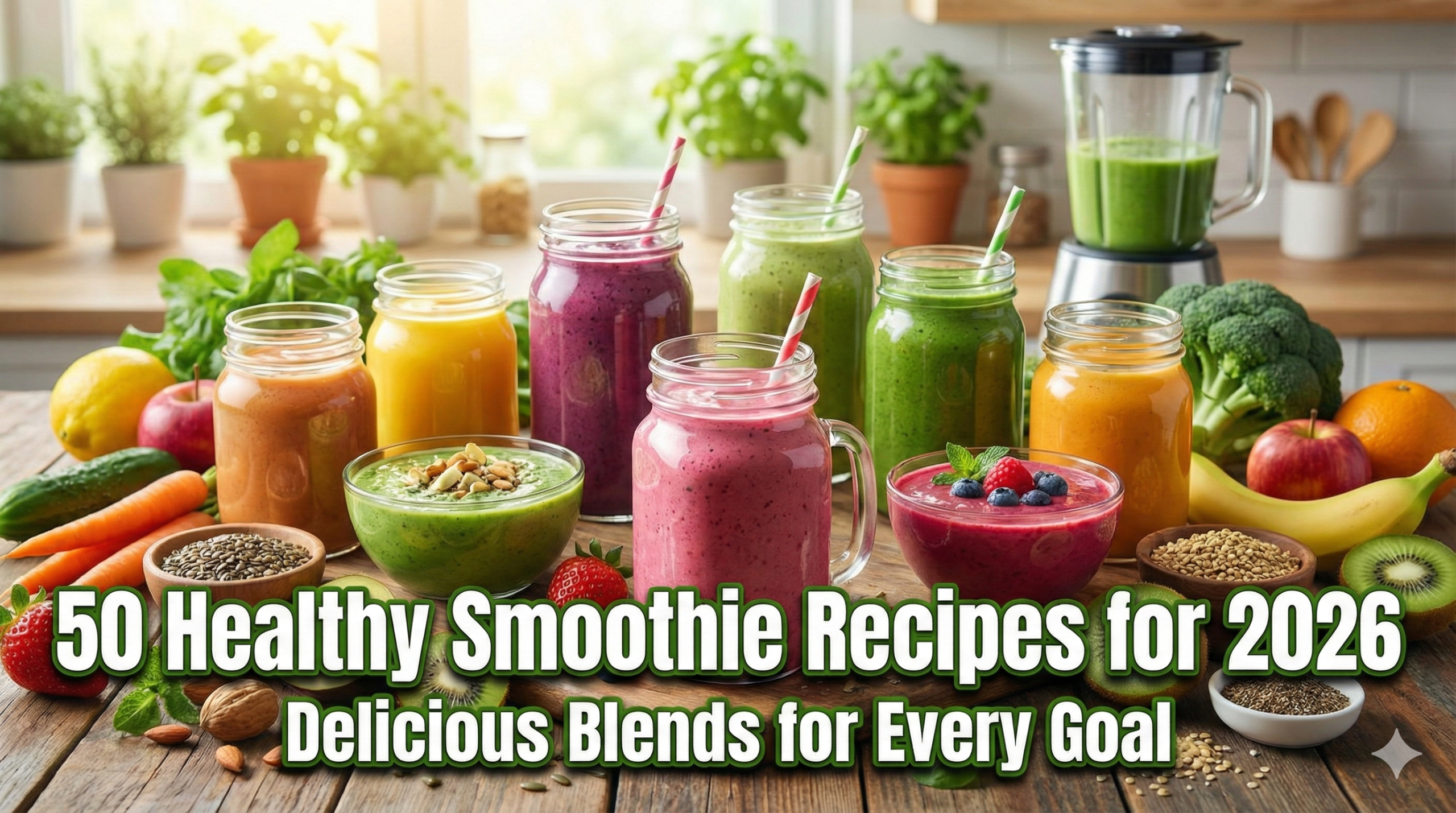
50 Healthy Smoothie Recipes for 2026: Delicious Blends for Every Goal
Finding healthy smoothie recipes 2026 that actually work comes down to understanding a few core principles most recipe sites skip over. The difference between a smoothie that keeps you satisfied for hours versus one that leaves you hungry 30 minutes later isn’t about adding more fruit—it’s about balancing macronutrients, choosing ingredients that complement each other, and knowing which combinations work for your specific routine.
This guide breaks down 50 tested smoothie recipes across different categories: energy-focused blends, nutrient-dense green smoothies, protein-packed options, and fruit-forward recipes for when you just want something that tastes good. Each category serves a different purpose, and knowing which type fits your morning routine or post-workout window makes the difference between a smoothie habit that sticks and one that fades after a week.
What most people miss is that healthy smoothie recipes aren’t just about what you put in the blender. Frozen versus fresh ingredients change texture dramatically. Greek yogurt versus plant-based alternatives affects both protein content and how long you stay full. Even the order you add ingredients matters for blending efficiency. The recipes here account for these variables, so you’re not guessing every time you make one.
What Makes a Smoothie Actually Healthy
The term “healthy smoothie” gets thrown around without much precision. Here’s what it actually means in practical terms: a blend that provides sustained energy without spiking blood sugar, includes whole food ingredients rather than processed additives, and fits within your overall nutritional needs for the day.
Most smoothies fail on the first point. Loading up fruit without any fat or protein creates a sugar rush followed by a crash. Your body processes fruit sugar (fructose) differently than refined sugar, but the impact on blood sugar is similar when consumed in liquid form without fiber-slowing elements. A truly healthy smoothie balances natural sugars with protein sources like Greek yogurt or nut butter, healthy fats from avocado or chia seeds, and fiber from whole fruits or vegetables.
The second factor is ingredient quality. Pre-made smoothie mixes often contain added sugars, artificial flavors, or stabilizers. Making smoothies from scratch means controlling exactly what goes in. Frozen fruit works just as well as fresh—sometimes better, since it’s frozen at peak ripeness and creates that thick, frosty texture without added ice that waters down flavor.
The third consideration is portion context. A 24-ounce smoothie might be a meal replacement, while an 8-ounce version works as a snack. Healthy doesn’t mean calorie-free; it means appropriate for how you’re using it. A smoothie intended to replace breakfast should provide 300-500 calories with substantial protein and fiber. A post-workout snack might be lighter at 150-200 calories, focused more on quick-absorbing carbohydrates.
Quick Summary
- Balance fruit with protein and healthy fats to avoid blood sugar spikes
- Whole food ingredients perform better than pre-made mixes
- Match smoothie size and composition to whether it’s a meal or snack
- Frozen fruit provides ideal texture and preserves nutrients
Core Ingredients That Appear Across Most Recipes
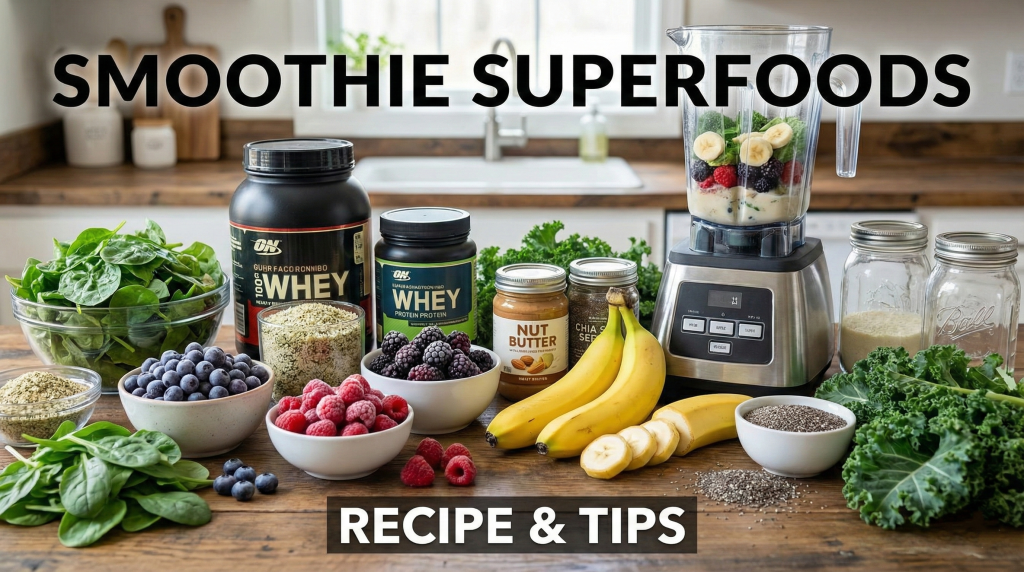
Before diving into specific recipes, understanding the building blocks helps you adapt any smoothie to your preferences or what’s in your fridge. These ingredients show up repeatedly because they solve specific functional problems beyond just taste.
Base Liquids: Milk, almond milk, oat milk, and coconut milk each bring different textures and flavors. Regular milk and oat milk create the creamiest texture. Almond milk is lighter and less calorie-dense. Coconut milk from a can is very thick with strong coconut flavor, while coconut milk from a carton is much lighter. The choice affects both taste and how filling the smoothie feels.
Frozen Fruit: Strawberries, blueberries, mango, pineapple, and bananas are smoothie staples. Frozen banana is particularly valuable—it creates thickness without needing ice, which can dilute flavor. One frozen banana adds natural sweetness and creamy texture to almost any blend. Keeping a variety of frozen fruit on hand means you can make smoothies year-round regardless of what’s in season.
Protein Sources: Greek yogurt packs the most protein per serving—a half-cup provides about 10-12 grams. Peanut butter, almond butter, and other nut butters add 7-8 grams per 2-tablespoon serving, plus healthy fats that increase satiety. Chia seeds contribute both protein and fiber, though the texture takes getting used to. Some recipes use rolled oats for a protein and fiber boost with a neutral flavor that blends smoothly.
Greens: Spinach and kale are the most common additions. Spinach has a milder flavor that disappears when blended with fruit. Kale is slightly more bitter and fibrous but provides more nutrients per cup. Fresh spinach works fine, but frozen spinach cubes are convenient and blend just as well. Start with one cup of greens if you’re new to green smoothies—the fruit masks the taste more than you’d expect.
Sweeteners: Many smoothies don’t need added sweetener if the fruit is ripe, but when you do want a touch more sweetness, maple syrup, honey, or agave nectar work well. A tablespoon or less is usually sufficient. These add about 50-60 calories but provide trace minerals that refined sugar doesn’t.
The ratio between these elements determines the final result. Too much liquid makes the smoothie thin and watery. Too little means the blender struggles and the texture is overly thick. Most recipes in this guide use about 1 cup of liquid for every 2-3 cups of solid ingredients (fruit, vegetables, yogurt combined). This creates a drinkable consistency that’s not too thin or too thick.
Key Takeaways
- Different base liquids create vastly different textures and calorie counts
- Frozen banana is the most versatile thickening ingredient
- Greek yogurt delivers the highest protein per volume
- One cup of greens blends invisibly when paired with fruit
- Standard ratio: 1 cup liquid to 2-3 cups solids
Berry-Based Smoothies: Strawberry, Blueberry, Raspberry, Mixed Berry
Berry smoothies dominate the healthy smoothie recipes 2026 category for good reason—they’re naturally sweet without needing much added sugar, pack high antioxidant levels, and create vibrant colors that look as good as they taste. The key difference between a mediocre berry smoothie and an excellent one comes down to balancing tartness.
The classic strawberry smoothie combines frozen strawberries, banana, Greek yogurt, and milk. The banana provides natural sweetness that offsets the slight tartness of strawberries. Using 2 cups frozen strawberries, 1 banana, 1/4 cup Greek yogurt, and 1 cup milk creates a thick, creamy blend. A tablespoon of maple syrup or honey adds just enough sweetness without going overboard. This combination provides roughly 15 grams of protein when using Greek yogurt, making it substantial enough for a breakfast replacement.
Variations work by swapping one fruit component. Strawberry banana smoothies use a 50/50 fruit split for more pronounced banana flavor. Strawberry blueberry blends create a deeper purple color and slightly more complex berry taste. Strawberry pineapple brings tropical brightness, while strawberry mango offers stone fruit richness. Each variation changes the sugar content slightly—mango and pineapple are sweeter, so you might skip added sweetener entirely.
Blueberry smoothies benefit from a hint of cinnamon, which complements blueberry’s subtle sweetness better than vanilla. The standard recipe uses 2 cups frozen blueberries, 1 banana, 1/4 cup Greek yogurt, 1 cup milk, and 1/4 teaspoon cinnamon. Blueberries are less sweet than strawberries, so this often needs a tablespoon of sweetener unless the banana is very ripe.
Raspberry smoothies lean more tart, which some people love and others find too intense. The solution is either pairing raspberries with sweeter fruits like mango or using a touch more sweetener. Two cups frozen raspberries, 1 banana, 1/4 cup yogurt, 1 cup milk, and 1-2 tablespoons maple syrup balances the tartness while preserving that distinctive raspberry flavor. According to the USDA FoodData Central, raspberries contain higher fiber per cup than most other berries, which contributes to the smoothie’s staying power.
Mixed berry smoothies work well when you want variety without committing to a single flavor. Combining strawberries, blueberries, and raspberries in equal parts creates a balanced berry flavor that’s neither too sweet nor too tart. Most people find a 50/50 split between mixed berries and banana works best, with the usual yogurt and milk base.
The trade-off with berry smoothies is seed texture. Raspberries and blackberries contain noticeable seeds that some people dislike. Blending longer doesn’t fully eliminate them—they’re small but present. Strawberries and blueberries have tiny seeds that blend away almost completely. If seed texture bothers you, stick to strawberry and blueberry combinations.
In Short
- Banana balances berry tartness better than additional sweetener
- Blueberries pair especially well with cinnamon
- Raspberries contain the most fiber but also the most noticeable seeds
- Mixed berry combinations create complex flavor without single-fruit intensity
Tropical Smoothies: Mango, Pineapple, Coconut, Kiwi
Tropical fruit smoothies bring a different flavor profile—brighter, more acidic, with natural sweetness that often eliminates the need for added sugars. These fruits also create particularly thick, creamy textures even without dairy products, making them ideal for vegan variations.
The basic mango smoothie uses frozen mango chunks, banana, and milk or coconut milk. Mango’s natural creaminess means you can skip yogurt entirely and still get a thick consistency. Two cups frozen mango, 1 banana, and 1 cup coconut milk creates something that tastes more like mango sorbet than a health drink. Mango contains natural sugars that make this one of the sweetest smoothies without any added sweetener. For reference, a cup of mango provides roughly the same sugar content as a banana but with different vitamins—mango is particularly high in vitamin A and C.
Pineapple smoothies work similarly but have more pronounced acidity. The standard version combines frozen pineapple, banana, and either coconut milk for tropical flavor or regular milk for less coconut taste. Two cups frozen pineapple, 1 banana, 1 cup liquid creates the right balance. Pineapple contains bromelain, an enzyme that breaks down protein—this is why fresh pineapple can make your mouth tingle. Frozen pineapple has less active bromelain, so the effect is minimal in smoothies.
Pina colada smoothies take the pineapple base and add coconut in two forms: coconut milk as the liquid and shredded coconut blended in for texture and flavor. This creates an intensely tropical taste that’s quite sweet on its own. Using 1.5 cups pineapple, 1 banana, 1 cup coconut milk, and 2 tablespoons shredded coconut hits that classic pina colada flavor profile without alcohol.
Kiwi smoothies are less common but surprisingly effective. Kiwi’s sweet-tart flavor sits somewhere between pineapple and strawberry. Peeling kiwis is the most time-consuming part—you can eat the skin, but most people prefer it peeled for smoothies. Three peeled kiwis, 1 cup frozen mango or pineapple, 1/2 banana, and 1 cup milk creates a bright green smoothie with complex fruity flavor. Kiwi contains more vitamin C per serving than oranges, according to NIH nutritional data.
General tropical smoothies combine multiple tropical fruits. Mango, pineapple, and banana together create a balanced tropical flavor where no single fruit dominates. Adding coconut milk instead of regular milk intensifies the tropical vibe. Using 1 cup mango, 1 cup pineapple, 1 banana, and 1 cup coconut milk is a reliable base recipe.
The main consideration with tropical smoothies is that they tend toward the sweeter end of the spectrum. If you’re watching sugar intake, these aren’t the lowest option even though the sugar comes from whole fruit. The fiber in whole fruit does slow sugar absorption compared to fruit juice, but liquid fruit still processes faster than eating whole pieces. For people managing blood sugar, pairing tropical smoothies with a protein-rich breakfast item helps moderate the glucose response.
What This Means
- Mango and pineapple create natural thickness without dairy
- Coconut milk amplifies tropical flavor but adds saturated fat
- Kiwi delivers more vitamin C than citrus fruits
- Tropical fruits are naturally sweeter, so added sugar is rarely needed
- Consider blood sugar impact if consuming alone on an empty stomach
Green Smoothies: Spinach, Kale, Celery, Cucumber
Green smoothies have a reputation for tasting like grass clippings, but that’s a recipe formulation problem, not an inherent issue with the concept. Done correctly, green smoothies taste primarily like the fruit with just a subtle vegetal undertone that most people don’t even notice.
The basic green smoothie combines spinach, apple, banana, and liquid. Spinach is the mildest green—it blends completely smooth and its flavor disappears when paired with fruit. Two cups fresh spinach (or 1 cup frozen spinach), 1 apple, 1 banana, and 1 cup liquid creates a green smoothie that tastes mostly like apple and banana. The spinach contributes a slight earthiness but nothing overwhelming. Using sweeter apple varieties like Fuji or Gala works better than tart Granny Smith unless you prefer that tartness.
Kale smoothies are slightly different. Kale has a more pronounced flavor and tougher texture that doesn’t blend quite as smoothly as spinach. Using frozen kale works better than fresh because freezing breaks down the cell walls, making it easier to blend. A kale smoothie works best with pineapple or mango rather than just banana and apple—the tropical fruit’s stronger flavor balances kale better. Two cups frozen kale, 1 cup pineapple, 1 banana, and 1 cup liquid creates a green smoothie where kale is present but not dominant.
Celery smoothies bring an interesting challenge. Raw celery has a strong, slightly bitter flavor that’s harder to mask than spinach or even kale. The solution is pairing celery with very sweet fruits and adding ginger, which creates complexity that distracts from celery’s bitterness. Two stalks celery, 1 green apple, 1 banana, 1/2 inch fresh ginger, and 1 cup liquid creates a smoothie where celery adds freshness without tasting like drinking salad. The ginger is key—without it, celery flavor dominates.
Cucumber smoothies are surprisingly refreshing. Cucumber is mostly water with very mild flavor, so it adds volume and hydration without much taste. Half a cucumber (peeled or unpeeled depending on preference), 1 cup pineapple, 1/2 cup spinach, and 1 cup coconut water creates a light, hydrating smoothie that’s lower in calories than most fruit-heavy versions. This works well on hot days or after workouts when you want something refreshing rather than filling.
The ratio of greens to fruit determines whether a smoothie tastes “green” or not. Starting with 1 cup greens to 2 cups fruit creates a smoothie where fruit flavor dominates. Increasing to 2 cups greens with the same amount of fruit brings more vegetable flavor forward. This isn’t necessarily bad—some people prefer that taste—but it’s something to adjust based on preference.
One often-overlooked factor: leafy greens add virtually no sugar but do add fiber and micronutrients. A spinach smoothie has significantly less sugar impact than a mango smoothie of the same size, even though both might taste equally sweet. The CDC’s nutrition guidelines suggest adults aim for 2-3 cups of vegetables daily—one green smoothie can cover a substantial portion of that target.
Bottom Line
- Spinach is the mildest green with nearly invisible flavor when blended
- Kale requires tropical fruit to balance its stronger taste
- Celery needs ginger to offset natural bitterness
- Cucumber adds hydration with minimal flavor or calories
- Green smoothies provide vegetable servings without the “eating vegetables” experience
Protein-Focused Smoothies: Peanut Butter, Greek Yogurt, Oats
When the goal is sustained energy rather than quick refreshment, protein-focused smoothies deliver. These blends keep you full longer by slowing digestion and providing amino acids that stabilize blood sugar. The key is adding protein without creating a thick, chalky texture.
Peanut butter banana smoothies are probably the most popular protein smoothie variation. Two tablespoons peanut butter, 1 frozen banana, 1/4 cup rolled oats, 1 cup milk, and optional cinnamon creates something that tastes remarkably similar to peanut butter cookie dough. The oats add fiber and thickness while contributing about 4 grams protein per 1/4 cup. The banana provides sweetness and creamy texture. Total protein lands around 15 grams depending on the milk type used.
The trade-off is calorie density. Peanut butter adds roughly 190 calories per 2 tablespoons, mostly from fat. This makes the smoothie more satisfying but also more calorie-dense than fruit-only versions. For people trying to manage calorie intake, measuring peanut butter precisely matters—it’s easy to accidentally pour 3-4 tablespoons instead of 2, which significantly changes the nutrition profile.
Greek yogurt smoothies take a different approach. Rather than nut butter, these rely on yogurt as the primary protein source. A vanilla protein smoothie uses 1 cup Greek yogurt, 1 banana, 1/2 cup frozen berries, 1/2 cup milk, and vanilla extract. This provides 20+ grams protein from the yogurt alone, making it a legitimate meal replacement. The texture is thicker and tangier than non-yogurt smoothies, which some people love and others find too pronounced.
Oatmeal smoothies sound strange but work surprisingly well. Blending raw rolled oats with banana, peanut butter, cinnamon, and milk creates a smoothie that tastes like drinking oatmeal—which is actually enjoyable when done right. The standard ratio is 1/3 cup oats, 1 banana, 2 tablespoons peanut butter, 1/4 teaspoon cinnamon, and 1 cup milk. The oats need about 30 seconds of blending to break down fully, otherwise you get gritty texture.
Almond butter smoothies function similarly to peanut butter versions but with slightly different flavor. Almond butter is a bit more expensive and has marginally different nutrition (slightly less protein, slightly more vitamin E), but the differences are modest. Using almond butter instead of peanut butter in any recipe works as a direct swap. Some people prefer almond butter’s subtler taste, while others find peanut butter has better “comfort food” association.
Chia seed smoothies add protein and omega-3 fatty acids, though the texture takes adjustment. Chia seeds gel when exposed to liquid, creating small gelatinous bits throughout the smoothie. Some people love this tapioca-like texture; others find it off-putting. Two tablespoons chia seeds adds 4 grams protein and 11 grams fiber. Adding chia to an existing smoothie recipe is straightforward—just blend them in with the other ingredients and let the smoothie sit for 2-3 minutes before drinking to allow gelling.
The protein strategy depends on your goal. If you need maximum protein (20+ grams), Greek yogurt is the most efficient choice. If you want moderate protein with healthy fats (10-15 grams), nut butter works well. If you prefer plant-based protein with fiber benefits, oats and chia seeds are solid options. All three can combine—a smoothie with Greek yogurt, peanut butter, and oats provides 25+ grams protein, though it becomes quite thick and filling.
Quick Summary
- Peanut butter provides 8g protein but 190 calories per 2 tablespoons
- Greek yogurt offers the highest protein-to-calorie ratio at 20g per cup
- Oats add both protein and fiber but require thorough blending
- Chia seeds contribute omega-3s but create gelatinous texture
- Combining protein sources (yogurt + nut butter) creates meal replacement-level satisfaction
Specialty Smoothies: Coffee, Chocolate, Matcha
Some smoothies serve specific purposes beyond general nutrition. Coffee smoothies provide caffeine plus nutrition for people who want to combine their morning coffee with breakfast. Chocolate smoothies satisfy dessert cravings with less sugar than actual dessert. Matcha smoothies deliver steady energy without the coffee jitters some people experience.
Coffee smoothies work by blending cold brew or regular brewed coffee (cooled) with banana, oats, almond butter, and milk. One cup cold brew, 1 frozen banana, 2 tablespoons almond butter, 1/4 cup oats, and 1/2 cup milk creates a smoothie that tastes like a healthier version of a fast-food frappe. The banana and almond butter offset coffee’s bitterness without needing much added sugar. The oats provide substance that makes this feel like a complete breakfast.
The caffeine content depends on coffee strength and volume. One cup of cold brew typically contains 150-200mg caffeine, which is roughly double a regular cup of hot coffee. If caffeine sensitivity is a concern, using half coffee and half regular milk reduces caffeine while maintaining flavor. Some people use decaf coffee for the flavor without the stimulant effect.
Chocolate peanut butter smoothies satisfy dessert cravings while providing actual nutrition. Two tablespoons cocoa powder (not hot chocolate mix—unsweetened cocoa powder only), 2 tablespoons peanut butter, 1 banana, 1 cup milk, and 1-2 tablespoons maple syrup creates something that tastes like a chocolate milkshake. Cocoa powder contributes antioxidants and a small amount of iron without adding much sugar. The peanut butter and banana create richness that makes the smoothie feel indulgent despite relatively modest sugar content.
Chocolate strawberry smoothies work similarly but pair cocoa with fruit instead of nut butter. Two cups frozen strawberries, 1 banana, 2 tablespoons cocoa powder, 2 tablespoons almond butter, and 1 cup milk creates a flavor reminiscent of chocolate-covered strawberries. The strawberries provide natural sweetness that reduces how much added sweetener is needed.
Matcha smoothies blend matcha green tea powder with fruit for steady, focused energy. One teaspoon matcha powder, 1 cup frozen pineapple, 1 banana, and 1 cup coconut milk creates a light green smoothie with subtle tea flavor underneath the tropical fruit. Matcha contains caffeine but releases it more gradually than coffee due to L-theanine, an amino acid that moderates caffeine’s effects. Most people report feeling alert without jitters or subsequent crashes.
The matcha quality matters significantly. Ceremonial grade matcha has smoother, more delicate flavor than culinary grade. For smoothies where matcha isn’t the primary flavor, culinary grade works fine and costs less. Using too much matcha (more than 1-2 teaspoons) can create bitter flavor, so starting with less and adjusting up is safer than the reverse.
These specialty smoothies typically work best as occasional treats rather than daily staples. A coffee smoothie every morning might lead to caffeine dependency. A chocolate smoothie daily might undermine efforts to reduce sugar cravings. Rotating between different smoothie types—berry smoothies some days, green smoothies others, specialty smoothies occasionally—provides variety and prevents flavor fatigue.
Key Takeaways
- Coffee smoothies combine caffeine and nutrition for efficient mornings
- Unsweetened cocoa powder adds chocolate flavor with minimal sugar
- Matcha provides steadier energy release than coffee
- Quality matcha matters less in fruit-heavy smoothies
- Specialty smoothies work best as rotation options, not daily defaults
Stone Fruit and Melon Smoothies: Peach, Cherry, Watermelon, Cantaloupe
Stone fruits and melons occupy a middle ground between berries and tropical fruits—they’re sweet but not as intensely so as mango, refreshing but more substantial than citrus. These fruits are strongly seasonal, making frozen versions particularly valuable for year-round smoothies.
Peach smoothies have natural sweetness with subtle floral notes. Two cups frozen peaches, 1/2 cup Greek yogurt, 1 cup milk, and 1/4 teaspoon each vanilla extract and cinnamon creates a smoothie that tastes like peach pie. Peaches pair exceptionally well with vanilla and cinnamon—these spices complement rather than compete with peach’s delicate flavor. The yogurt adds tang that balances sweetness without making the smoothie tart.
Peach mango smoothies combine stone fruit with tropical fruit for a flavor that’s complex but not overwhelming. One cup frozen peaches, 1 cup frozen mango, 1/2 banana, and 1 cup coconut milk creates a thick, creamy blend where both fruits are present but neither dominates. This combination works particularly well for people who find single-fruit smoothies one-dimensional.
Cherry smoothies require frozen cherries—fresh cherries are too much work to pit for smoothies. Two cups frozen cherries, 1 banana, 1/2 cup Greek yogurt, 1 cup milk, and 1/4 teaspoon vanilla creates a deep red smoothie with pronounced cherry flavor. Cherries are tart even when ripe, so this often needs 1-2 tablespoons sweetener unless you prefer tart smoothies. According to nutritional data from the USDA, cherries contain compounds that may support post-exercise recovery, which is why some athletes specifically use cherry smoothies after workouts.
Watermelon smoothies are ultra-refreshing but thin unless properly balanced. Watermelon is 92% water, so using watermelon alone creates something closer to watermelon juice than a smoothie. The solution is adding frozen banana or frozen strawberries for thickness. Two cups frozen watermelon chunks, 1 frozen banana, and 1/2 cup frozen strawberries creates a pink smoothie with good texture and bright flavor. Watermelon smoothies are naturally lower in calories than most fruit smoothies due to high water content—this makes them ideal for hot weather or post-workout when hydration matters more than calorie density.
Cantaloupe smoothies have delicate, subtly sweet flavor that some people love and others find too mild. One cup frozen cantaloupe, 1 cup frozen pineapple, 1/2 cup Greek yogurt, and 1/2 cup coconut water creates a smoothie where cantaloupe contributes melon freshness while pineapple provides tropical sweetness. Cantaloupe alone might feel underwhelming, but combined with other fruits it adds complexity.
Honeydew smoothies work similarly to cantaloupe but are slightly sweeter. Honeydew pairs well with honey and vanilla—one cup frozen honeydew, 1 banana, 1 cup milk, 1 tablespoon honey, and 1/2 teaspoon vanilla creates a pale green smoothie with gentle sweetness. Honeydew has a devoted following among people who prefer subtle flavors over fruit-forward intensity.
Stone fruit and melon smoothies tend to be more seasonal in people’s minds even when using frozen fruit. Peaches feel summery. Watermelon is definitively warm-weather. This isn’t necessarily bad—rotating smoothie types by season provides natural variety. Berry smoothies in spring, stone fruit in summer, apple and pumpkin in fall, citrus in winter creates a pattern that follows produce seasonality even when relying on frozen fruit.
In Short
- Peach pairs exceptionally with vanilla and cinnamon
- Cherries are naturally tart and typically need added sweetener
- Watermelon requires banana or other frozen fruit for proper thickness
- Cantaloupe and honeydew have subtle flavor best combined with stronger fruits
- Stone fruit and melon smoothies feel most satisfying in warm weather
Citrus and Uncommon Fruit Smoothies: Orange, Lemon, Grapefruit, Pomegranate
Citrus fruits and less common smoothie ingredients open up different flavor possibilities. These smoothies lean tart or tangy rather than straight sweet, which appeals to people who find berry and tropical smoothies too sugary.
Orange smoothies taste like creamier, thicker versions of orange juice. Two peeled oranges (remove white pith), 1 frozen banana, 1/2 cup Greek yogurt, 1/2 cup milk, and 1/2 teaspoon vanilla creates something reminiscent of an Orange Julius. The key is removing all white pith from the oranges—it adds bitterness that clashes with the smoothie’s intended sweetness. Oranges provide high vitamin C content without requiring any added sweetener if the banana is ripe.
Lemon smoothies are intensely citrusy and definitely not for everyone. The zest from one lemon, juice from one lemon, 1 cup frozen pineapple, 1 frozen banana, 1/2 cup Greek yogurt, and 1 tablespoon honey creates a very tart, refreshing smoothie. Using both zest and juice provides full lemon flavor—zest contains oils that deliver aroma and brightness beyond what juice alone provides. This smoothie needs sweetener; lemon is too tart otherwise.
Grapefruit smoothies balance bitter, tart, and sweet elements. One grapefruit (peeled and white pith removed), 1 cup frozen pineapple, 1 banana, and 1 cup coconut water creates a pink smoothie with complex flavor. Grapefruit’s natural bitterness is an acquired taste—some people love it, others find it unpleasant. Pairing it with very sweet pineapple moderates the bitterness without eliminating grapefruit’s distinctive character.
Pomegranate smoothies use pomegranate juice rather than whole seeds (removing seeds from pomegranate is tedious). One cup pomegranate juice, 1 cup frozen pineapple, 1 frozen banana, and 1/2 cup Greek yogurt creates a vibrant pink-red smoothie with sweet-tart flavor. Pomegranate juice is expensive compared to other smoothie liquids, but it provides concentrated flavor and deep color. Using pomegranate juice as the liquid base instead of milk or water creates the most pronounced pomegranate flavor.
Dragon fruit smoothies have become popular for their brilliant pink color, though the flavor is subtle. Frozen dragon fruit (pitaya) puree is available at many grocery stores. One packet frozen dragon fruit, 1 cup frozen mango, 1 cup frozen pineapple, 1 banana, and 1 cup coconut water creates a magenta smoothie that’s more about visual appeal than strong flavor. Dragon fruit itself tastes mildly sweet with slight texture from tiny black seeds throughout. It provides the color but other fruits provide most of the flavor.
Acai smoothies use frozen acai puree similarly to dragon fruit. Acai has a flavor that’s hard to describe—vaguely berry-like with chocolate undertones. One packet frozen acai, 1 cup frozen blueberries, 1 banana, and 1 cup liquid creates a purple-brown smoothie that’s popular in smoothie bowl culture. Acai puree is expensive and provides antioxidants, though whether acai delivers health benefits beyond other berries is unclear—marketing emphasizes acai’s “superfood” status, but nutritional data from the NIH doesn’t show dramatic differences compared to blueberries or strawberries.
These uncommon fruits often cost more than standard smoothie ingredients. A pomegranate smoothie might cost $4-5 to make at home compared to $1-2 for a strawberry banana smoothie. Whether the flavor difference justifies the cost is personal preference. For people who find standard smoothies boring, these variations provide interesting alternatives without being dramatically more complex to prepare.
What This Means
- Citrus smoothies require sweetener to balance tartness
- Remove white pith from oranges and grapefruit before blending
- Dragon fruit provides color but subtle flavor
- Pomegranate juice works better than whole seeds for smoothies
- Acai costs more than conventional berries without clear nutritional advantage
Vegetable-Forward Smoothies: Carrot, Beet, Broccoli, Avocado
Vegetable smoothies sound unappealing to many people, but done correctly they provide nutrient density that fruit smoothies can’t match while still tasting good. The approach is always the same: pair vegetables with sweet fruit and use spices or citrus to add complexity.
Carrot smoothies work because carrots are naturally sweet. One cup chopped carrots (raw or lightly steamed), 1 orange, 1 cup frozen mango, 1/2 cup pineapple juice, and 1/4 teaspoon ginger creates a bright orange smoothie where carrot blends seamlessly with fruit. Carrots contribute earthy sweetness that complements tropical fruit well. Using steamed carrots instead of raw makes blending easier and the texture smoother, though either works.
Beet smoothies require managing beet’s earthy flavor, which is more pronounced than carrot. One small beet (cooked and peeled), 1 cup frozen pineapple, 1 apple, 1 banana, and 1 cup coconut water creates a magenta smoothie where beet flavor is present but balanced by fruit. Raw beets are harder to blend than cooked—cooking softens them and makes the texture smoother. Beets also stain everything they touch, so be prepared for pink-stained blender and hands.
Broccoli smoothies sound terrible but actually work when executed correctly. One cup frozen broccoli florets, 1 cup frozen pineapple, 1 cup frozen mango, 1 banana, and 1 cup liquid creates a green-yellow smoothie where broccoli adds substance and nutrients without dominating flavor. Frozen broccoli works better than raw because it’s already broken down, blending smoother. Using sweet tropical fruits is essential—pairing broccoli with berries doesn’t mask the vegetable flavor as effectively.
Avocado smoothies are technically fruit but functionally vegetable in terms of flavor. Half an avocado, 1 cup frozen pineapple, 1 banana, 1 cup coconut milk, and juice of 1 lime creates an ultra-creamy pale green smoothie. Avocado contributes almost no flavor but dramatically changes texture, making the smoothie thick and rich. This is one of the most filling smoothies due to avocado’s fat content—the same half avocado contains roughly 120 calories, almost all from healthy monounsaturated fat.
The principle with all vegetable smoothies is that vegetables provide the nutrition while fruit provides the flavor. A smoothie that’s 50% vegetables and 50% fruit by volume delivers far more micronutrients than a fruit-only smoothie at similar calorie levels. The American Heart Association’s dietary guidelines suggest increasing vegetable intake across all eating occasions, and smoothies are one of the few ways vegetables work in a traditionally sweet context.
The limitation is that some vegetables don’t work in smoothies no matter how you try. Cauliflower creates gritty texture. Bell peppers add harsh flavor. Tomatoes make smoothies taste like gazpacho. Leafy greens (spinach, kale), root vegetables (carrot, beet), and mild vegetables like cucumber and celery work. Strongly flavored or fibrous vegetables don’t.
Bottom Line
- Root vegetables (carrot, beet) blend smoothly when cooked first
- Tropical fruits mask vegetable flavors better than berries
- Avocado changes texture dramatically without adding vegetable flavor
- Frozen vegetables blend smoother than raw in most cases
- Not all vegetables work—stick to mild or naturally sweet options
Vegan and Dairy-Free Smoothie Adaptations
Any smoothie recipe converts to vegan by swapping dairy milk for plant milk and replacing Greek yogurt with plant-based alternatives. The texture and flavor change somewhat, but most substitutions work well once you understand the differences.
Oat milk creates the creamiest texture among plant milks. It’s slightly sweet and has a mild flavor that doesn’t compete with fruit. For smoothies where you want rich, creamy texture similar to dairy milk, oat milk is the best choice. The main consideration is that oat milk contains more calories and carbohydrates than almond or coconut milk—roughly 120 calories per cup compared to 30-40 for unsweetened almond milk.
Almond milk is lighter and more neutral. It works well when you want the liquid for blending without adding much flavor or calories. Unsweetened almond milk provides a blank canvas that lets fruit flavor dominate. The downside is that it’s less filling than oat or coconut milk, so smoothies made with almond milk might not keep you satisfied as long.
Coconut milk from a can is very thick and adds strong coconut flavor. This works perfectly for tropical smoothies where coconut flavor enhances the overall taste. For non-tropical smoothies, the coconut flavor might clash. Coconut milk from a carton is much lighter (closer to almond milk) but still carries some coconut taste. Reading the label matters—canned coconut milk is dramatically different from carton coconut milk despite the same name.
Soy milk falls somewhere between oat milk and almond milk in texture. It’s slightly thicker than almond but not as creamy as oat. Soy milk has mild bean flavor that some people notice, though most don’t find it objectionable in smoothies. Soy milk provides more protein than other plant milks (about 7 grams per cup), making it a good choice for protein-focused smoothies without dairy.
Plant-based yogurt alternatives include coconut yogurt, almond yogurt, cashew yogurt, and soy yogurt. Coconut yogurt has the strongest flavor—it works in tropical smoothies but overwhelms berry smoothies. Cashew yogurt and soy yogurt are more neutral and work as closer substitutes for Greek yogurt, though neither provides the same protein content. The texture is similar to regular yogurt but protein per serving is usually 2-3 grams instead of 10-12 grams for Greek yogurt.
For vegans prioritizing protein, adding plant-based protein powder is one option, though this guide generally avoids protein powder since it often creates chalky texture and artificial taste. Better alternatives are combining soy milk (for base protein) with nut butter and chia seeds or oats. A smoothie with soy milk, peanut butter, and oats provides 15-20 grams plant-based protein without powder.
The main trade-off with vegan smoothies is protein content unless you actively address it. A dairy-based smoothie with Greek yogurt easily hits 15-20 grams protein. The same smoothie with almond milk and no yogurt might have only 3-4 grams protein. This doesn’t make vegan smoothies nutritionally inferior, but it requires conscious ingredient choices to match protein levels.
Quick Summary
- Oat milk provides creamiest plant-based texture
- Almond milk is neutral and low-calorie but less filling
- Coconut milk adds strong flavor suitable for tropical smoothies
- Soy milk offers most plant-based protein at 7g per cup
- Vegan smoothies need intentional protein additions to match dairy versions
Making Smoothies Ahead: Storage and Meal Prep
Freshly blended smoothies taste best, but prep strategies exist for people who need efficiency over perfection. The approach depends on whether you’re prepping ingredients or making complete smoothies in advance.
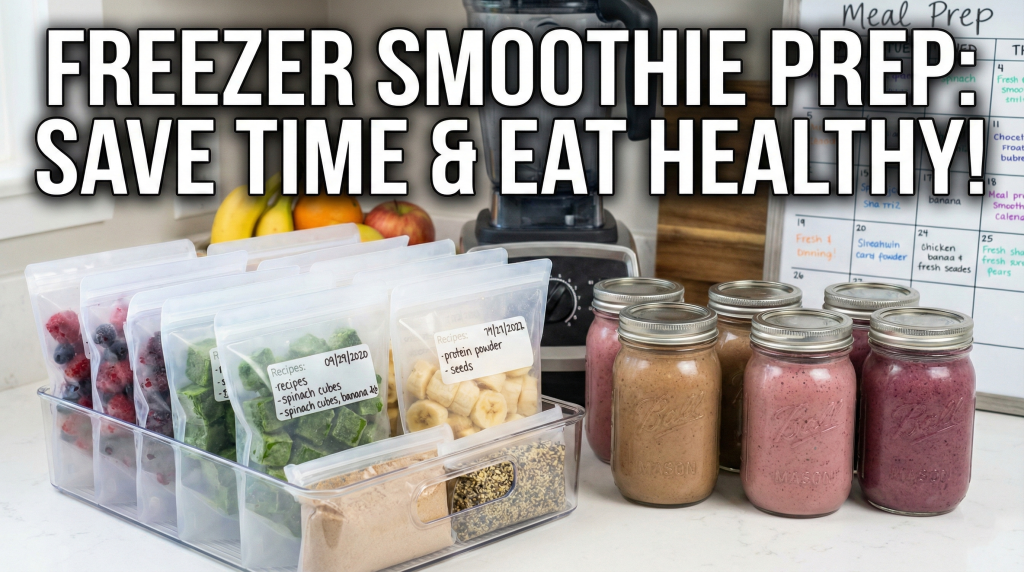
Freezer smoothie packs are the most effective prep method. Portion all frozen ingredients (fruit, greens, any add-ins) into freezer bags or containers. Leave out liquid—add it fresh when blending. This means morning smoothies require only dumping a freezer pack into the blender, adding liquid, and blending. The prep time happens once per week rather than every morning.
A typical smoothie pack contains: 2 cups frozen fruit, 1 cup fresh or frozen greens (if using), measured portions of any oats or chia seeds. Write the required liquid amount on the bag. When ready to blend, add the specified liquid plus any fresh additions like banana or yogurt, then blend. This saves 5-7 minutes per smoothie since you’re not measuring ingredients each time.
Pre-made smoothies last 1-2 days refrigerated in sealed containers. Mason jars work well—fill to the top to minimize air exposure. Smoothies separate during storage, which is normal. The liquid settles to the bottom while thicker components rise. Shake vigorously before drinking and texture returns to mostly normal. Some smoothies handle storage better than others—berry and tropical smoothies keep well, while green smoothies may develop slightly bitter flavor after 24 hours.
Freezing complete smoothies is possible but texture suffers. The smoothie freezes solid, requiring either thawing overnight in the refrigerator or letting it sit at room temperature for 20-30 minutes. The texture after thawing is acceptable but not as creamy as fresh. This works for people who need grab-and-go options and don’t mind slightly compromised texture.
Smoothie ice cubes are another prep option. Blend a large batch of smoothie, pour into ice cube trays, freeze. When ready for a smoothie, blend the frozen cubes with a small amount of fresh liquid. This replicates fresh-blended texture better than freezing an entire smoothie in a container. The downside is ice cube trays take up significant freezer space and require more containers than freezer packs.
The biggest prep mistake is adding banana to freezer packs. Bananas are fine frozen, but peeling frozen bananas is nearly impossible. Either peel bananas before freezing them separately, or add them fresh each morning. The few seconds of peeling a banana is worth avoiding the frustration of dealing with frozen peels.
Ingredient shopping for smoothie prep works best when focusing on frozen fruit. Buying fresh fruit specifically for smoothies means it might go bad before you use it. Frozen fruit is already prepped, doesn’t spoil, and creates better texture. Stock up on several varieties so you can rotate flavors without running to the store constantly.
Key Takeaways
- Freezer packs of portioned ingredients save time without texture loss
- Pre-made smoothies last 1-2 days refrigerated
- Shake refrigerated smoothies before drinking to reconstitute texture
- Freeze bananas peeled or add them fresh to avoid peeling difficulties
- Focus shopping on frozen fruit for convenience and shelf stability
Troubleshooting Common Smoothie Problems
Most smoothie issues come down to ratio problems or ingredient sequencing. Here’s how to fix the most common complaints.
Too thick: The blender struggles, ingredients don’t incorporate evenly, and the result is more like soft-serve than a drinkable smoothie. This happens when there’s too much frozen fruit relative to liquid. Solution: Add more liquid 1/4 cup at a time while blending. Or reduce frozen fruit by 1/2 cup. Or add fresh fruit instead of all frozen. Thick isn’t necessarily bad if you’re eating it with a spoon, but for drinking through a straw it’s a problem.
Too thin: The smoothie is watery and lacks body. This usually means too much liquid or not enough frozen ingredients. Solution: Add more frozen fruit or ice. Or use less liquid next time. Frozen banana is the best emergency thickener since it’s neutral-flavored and adds body without changing the smoothie’s flavor profile significantly.
Not sweet enough: The smoothie tastes bland or too tart. This often happens with berry smoothies when the fruit isn’t peak ripeness. Solution: Add 1 tablespoon sweetener (maple syrup, honey, agave). Or add half a very ripe banana—the riper the banana (more brown spots), the sweeter it is. Or add a few pitted dates, which provide natural sweetness plus some texture.
Too bitter: Green smoothies in particular can taste bitter if the ratio of greens to fruit is too high. Solution: Reduce greens by half next time. Or add sweeter fruit—mango, pineapple, and very ripe banana mask bitterness better than berries. Or add a pinch of salt, which surprisingly reduces perceived bitterness.
Gritty texture: Usually caused by inadequate blending of ingredients like oats, chia seeds, or leafy greens. Solution: Blend longer—give it an extra 30 seconds. Or blend leafy greens with the liquid first before adding frozen fruit. Or soak chia seeds in the liquid for 5 minutes before blending. Or use finer oat flour instead of whole rolled oats.
Ingredient order matters more than most people realize. Correct sequence for most blenders: liquid first, then powders (cocoa, matcha, oats), then fresh ingredients (banana, yogurt), then leafy greens, then frozen fruit and ice on top. This allows the blades to move freely initially rather than jamming against frozen chunks. Breaking this order is the #1 reason home blenders struggle.
Blender power limitations: Some smoothies are beyond what cheap blenders can handle. Frozen berries with seeds (raspberries, blackberries) require more power than soft fruits like mango. Leafy greens need high speed to break down cell walls. If your blender consistently struggles, the issue might be the machine rather than the recipe. Investing in a more powerful blender (300+ watts minimum) solves most texture and blending problems permanently.
Flavor combinations that don’t work: Some fruits clash rather than complement. Citrus and dairy sometimes curdle if the citrus is very acidic and sits too long before drinking. Banana overpowers delicate fruits like honeydew. Coconut flavor clashes with berries for some palates. There’s no universal rule—personal taste varies—but being aware that not all fruits combine well prevents disappointing experiments.
In Short
- Add liquid for too-thick smoothies, frozen fruit or banana for too-thin
- Sweetness fixes: maple syrup, very ripe banana, or dates
- Bitterness reduces with more fruit or counterintuitively, a pinch of salt
- Blend longer for gritty texture, or adjust ingredient form (oat flour vs whole oats)
- Blender power matters more than technique for difficult ingredients
Equipment Considerations: Blenders and Tools
The blender determines what smoothies you can successfully make. A weak blender limits ingredient options and creates inferior texture no matter how good the recipe is.
Minimum requirements: 300-watt motor, 40-ounce capacity, pulse function. Below 300 watts, frozen fruit and ice cause most blenders to stall or struggle. Below 40 ounces, making multiple servings requires batch blending. Without pulse function, controlling texture becomes harder.
Mid-range blenders (300-700 watts) handle most home smoothie needs. These blend frozen fruit smoothly, incorporate leafy greens acceptably, and create drinkable texture in 30-60 seconds. Brands at this tier cost $40-100. They’re not indestructible but last several years with regular use.
High-end blenders (1000+ watts) turn any ingredient into silk-smooth puree. These are the machines professional smoothie shops use. They pulverize ice into snow, break down tough kale stems completely, and blend frozen berries with seeds until no texture remains. Vitamix and Blendtec are the standard names. They cost $300-500 but last 10+ years. For people making smoothies daily, the investment makes sense. For occasional smoothie makers, it’s overkill.
Personal blenders work for single servings but have limitations. The small containers (12-20 ounces) restrict batch size. The smaller motors (200-300 watts) struggle with tough ingredients. The advantage is convenience—blend directly in a portable cup. This works for simple smoothies (frozen berries, banana, liquid) but fails with green smoothies or anything requiring more power.
Accessories that matter:
Tamper: A stick that pushes ingredients toward the blades while blending. High-end blenders include these. They’re invaluable for thick smoothies where ingredients sit above the blades refusing to blend. Makeshift tampers (wooden spoon) work but require removing the lid, which is less efficient.
Mason jars: Glass containers with tight lids store pre-made smoothies better than plastic. They don’t absorb colors or odors. Wide-mouth versions make pouring easier. A set of 16-ounce mason jars is inexpensive and useful beyond smoothies.
Reusable straws: Wide-bore straws (10mm diameter) work better for thick smoothies than standard straws (6mm). Metal or silicone straws are more sustainable than disposable. Some people prefer drinking smoothies directly from a cup or jar rather than using straws.
Cleaning: Blenders need cleaning immediately after use or the residue dries and becomes difficult to remove. The fastest cleaning method: add warm water and a drop of dish soap to the dirty blender, blend for 30 seconds, rinse. This removes 90% of residue without scrubbing. Once per week, disassemble and clean the blade assembly thoroughly since fruit particles accumulate in the seal.
Blender quality affects results more than recipe tweaking. A perfect recipe in a weak blender yields mediocre smoothies. A mediocre recipe in a powerful blender yields good smoothies. If you’re consistently unhappy with smoothie texture despite trying multiple recipes, the blender is likely the limiting factor.
Bottom Line
- 300+ watt motor minimum for frozen fruit and ice
- Mid-range blenders ($40-100) handle most home needs
- High-end blenders ($300-500) justify cost for daily users
- Personal blenders work for simple smoothies but have power limitations
- Clean immediately by blending water and soap for 30 seconds
Final Considerations for Building a Sustainable Smoothie Habit
Creating healthy smoothie recipes 2026 you actually stick with requires matching smoothies to your actual routine rather than an idealized version. Most people start strong then fade after a few weeks. Here’s what determines whether smoothies become permanent or temporary.
Morning vs. other times: Smoothies work well for breakfast if you typically skip it or eat something minimal. The portability and speed mean you can consume nutrition without sitting down. Smoothies work poorly for breakfast if you genuinely enjoy cooking eggs or other hot breakfast. Forcing smoothies when you’d rather have something else creates resentment that undermines the habit. Similarly, smoothies work as post-workout nutrition or afternoon snacks for people who want something quick and healthy. They don’t work as dinner replacements—most people want to chew food and feel satisfied, which smoothies don’t provide at the end of the day.
Variety management: Rotation prevents flavor fatigue. Making the same smoothie daily for two weeks makes you hate that smoothie. Having 4-5 regular recipes you rotate keeps things interesting without requiring decision-making every morning. The smoothies don’t need to be wildly different—strawberry banana one day, mango pineapple another, green smoothie third, peanut butter banana fourth, mixed berry fifth, then repeat. Small variations maintain interest.
Realistic ingredient availability: Stock ingredients you’ll actually buy and use. If fresh ginger sounds good but you never remember to buy it, stop including ginger in recipes. If matcha powder sits unused in the cabinet, accept that matcha smoothies aren’t your thing. Build recipes around ingredients you consistently have—frozen fruit, bananas, milk, yogurt. Everything else is optional.
Cost awareness: Smoothies can be expensive if you buy premium ingredients unnecessarily. Frozen fruit costs less than fresh and works better. Store-brand Greek yogurt performs identically to name brands. Almond butter from the bulk bin costs half the price of jarred name-brand versions. A typical smoothie should cost $1.50-3.00 to make at home. If homemade smoothies cost $5+ per serving, you’re either buying expensive ingredients unnecessarily or making portions too large.
Hunger and satisfaction: Smoothies keep some people full for hours and leave others hungry within an hour. This depends on individual digestion, what else you eat during the day, and the smoothie’s composition. If smoothies consistently leave you hungry, they might not work as meal replacements for you—use them as snacks instead. Or significantly increase protein and fat content by adding more nut butter and Greek yogurt. A 300-calorie smoothie with minimal protein won’t satisfy someone who needs 500+ calories and 25+ grams protein at breakfast.
The goal isn’t perfect smoothies every day. It’s smoothies that fit your life well enough that you continue making them without it feeling like a chore. If that means simpler recipes, buying pre-portioned freezer packs, or making smoothies only 3 days per week instead of 7, that’s fine. Consistency at a sustainable level beats perfection that lasts two weeks then stops entirely.
What This Means
- Match smoothies to your actual routine, not an ideal version
- Rotate 4-5 regular recipes rather than constantly seeking novelty
- Stock only ingredients you consistently buy and use
- Target $1.50-3.00 per homemade smoothie for cost sustainability
- Adjust protein/fat if smoothies don’t keep you satisfied